Showing posts with label singularity. Show all posts

Wednesday, December 21, 2011

2006 Locus SF – ACCELERANDO by Charles Stross


Am I really supposed to take this singularity thing seriously?  Really?  Advanced AIs and a proposal to Von Neumann factory the moon out of existence, set in the 2010s? Like theology, the sort of techno-optimism that proponents of singularity back is fun to talk about, but it can quickly and effortlessly segue into the ridiculous. Stross’s saving grace is that he doesn’t seem to take the singularity seriously either. I get the impression that he is a believer, but this novel is about 30% serious speculation and 70% running wild with speculative concepts. I do like that Accelerando embraces the ridiculous. I just wish it had embraced plot and character with equal fervor.

This is especially true in the first part, where we have at least some contemporary reference points to ground us. The novel begins with Manfred Macx, a man filled to the brim with tech ideas, but, due to a general dislike of wealth, he usually gives them away to make other people rich. He also has a lot of conflicts with his dominatrix/wife Pamela. He helps to kick off the rapid push towards singularity by sending software copies of lobster brains that have collectively achieved intelligence into space. From there, we get this accelerating technology developing through singularity. Stross occasionally interjects with a summation of the latest changes; by the 2030s, the solar system and the human lifecycle begin to become unrecognizable. From there we get a generational epic. Manfred’s daughter Amber explores an alien wormhole network, his grandson Sirhan works with other family members to try to find an independent niche in the new solar system, copies of the original generation pop up, and the family robocat, Aineko, has a fairly big role to play in everything.

Where does all this wacky speculation leave character and plot? Nowhere to be found, really, as might be fairly obvious from that vain stab at summarizing them. Manfred has some presence (though even he’s straight out of a Warren Ellis comic). Everyone is either so dull, on the one hand, or so wild unpredictable, on the other, that I couldn’t really tell you anything about them. The fact that there’s no plot is underlined by the fact that there’s no end. Maybe the sequel Glasshouse carries things to a more satisfying conclusion, but this novel just peters out.

Also, going back to our old accessibility discussion, this book . . . no. Not at all. Stross throws out concepts at a dizzying speed, and he rarely stops to explain them. Do you know what a Von Neumann machine is? A Matrioshka brain? I did, but I barely kept up. I don’t really see the reason to not define terms like these. One of the great things about sf is the “sense of wonder,” and I guess that’s what Stross is shooting for with this assault of Big Ideas. However, Big Ideas have dimishing returns, as far as I’m concerned, and the Idea-per-page highwire act in this book got boring for me by the mid-point. When the characters spend all of their time discussing how much computing power there is in the solar system and how very impressive that is, it’s hard to care about anything.

A whole lot of writers in this decade, and, from what I’ve seen, Stross may be the worst offender, are working to make science fiction a more insular conversation. If you don’t have a solid grounding in foundational texts and you don’t follow the right science news sites, don’t bother showing up. And people wonder why readers are turning to fantasy and steampunk?

So, if you are the type of reader who’s up-to-date on sf terms and concepts, especially relating to the singularity, and you’re more interested in Big Ideas and being amused than plot and character, I think you’ll have a great time with this book. Obviously, lots of readers have. Otherwise, go nowhere near it.

Grade: C+

Sunday, December 11, 2011

2006 Hugo – SPIN by Robert Charles Wilson


There’s a recent trend in science fiction to push further and to go bigger that goes along with Big Ideas like singularity.  Why worry about life in a thousand years, when we can imagine a billion years in the future?  I have mixed feelings about this trend, but I think it’s fair to say that it’s not an approach that tends to spotlight character, which was never sf’s strong suit anyway.  In Spin, however, Wilson’s come up with a very ingenious way to tell a personal story that spans three billion years.

Our narrator is Tyler Dupree.  He grows up on the estate of an aerospace entrepreneur named E. D. Lawton, and hangs out with E. D.’s twin prodigies, Jason and Diane.  One evening in the early twentieth century, when they’re all adolescents, the stars go out.  It soon becomes clear that the Earth has been enveloped in a bubble by mysterious “hypothetical” forces.  The bubble protects the Earth and slows the passage of time within, so that millions, then billions, of years begin to fly by on the outside, in a phenomenon people call “spin.”  Unfortunately, this means that the sun’s death throes will destroy the Earth in decades rather than billions of years, and humanity has to contemplate its doom within a human lifespan.  Jason becomes a brilliant scientist and develops plans to understand and even fight the hypotheticals.  Diane joins a new strain of Christianity that devolves from neo-hippies to a millennium cult.  Tyler tries to live a quiet life as a doctor, but he loves Jason, he’s in love with Diane, and he keeps being drawn into their struggles with the spin.  This is my second Wilson novel…and the second one with a narrator slavishly devoted to a smarter, better, yet aloof hero.  I don’t know if this is a device Wilson is overly fond of, or a personal issue for him.

There are obviously big sf ideas here.  Besides the spin itself, Jason’s plans usually involve using the time differential to jumpstart technology.  His coolest plan involves seeding Mars with life and seeing what a few million years of evolution can pull off.  Nevertheless, it is really a character-focused story, as we spend all of our time with Jason, and we hear as much about the Lawtons’ familial disputes as we do about Martian super-technology.  The problem is that I didn’t like the characters all that much.  Tyler is defined almost entirely by his relationship to the Lawtons, Jason is obsessed with solving the spin to the exclusion of all else, and Diane is so damn frustrating.  I have sympathy for people who are victimized by cults, but I think I’d find it a bit of a turn off.  Cult-Diane treats Tyler terribly and herself even worse, and there’s nothing here to give any indication as to why the narrator is so in love with her.

So, kudos to Wilson for spotlighting character drama over Big Ideas, but, unfortunately, I enjoyed the Big Ideas a lot more than the character drama in this specific novel.  I still liked it overall though.

Grade: B+

Sunday, November 13, 2011

2004 BSFA – RIVER OF GODS by Ian McDonald


I reviewed McDonald’s novella “Vishnu at the Cat’s Circus” for the 2010 Hugos and speculated that I might like it better once I was introduced to the wider world. The answer is “yes.” McDonald’s India of 2047, it’s centennial celebration (the novel has the unusual subtitle Happy Birthday India), is a fascinating setting, and it allows him to explore familiar post-cyberpunk themes in a way that few authors I’ve read have matched.

As I mentioned in my “Vishnu” review, McDonald’s futurism tends towards the optimistic (there’s a bit of my old foe, the singularity, at play here). Artificial Intelligences, called “aeais,” are common, but their sophistication is capped by international law pushed by the U.S. Still, they have wide applications in warfare, administration, science, and entertainment (a virtual soap opera called Town and Country plays a key role). There have also been genetic advances, including the slowly aging but long-lived and brilliant Brahmin (covered more in “Vishnu”). Meanwhile, India still suffers from old ethnic conflicts and the environmental problems of climate change and its own diverse geography. The novel centers around Varanasi, an ancient city and Hindu religious center. The region is in a three year drought and a water war looms while fundamentalist Hindus are on the verge of rioting.

McDonald introduces his world through a very broad cast of characters. There’s the comedian who inherits an Indian tech company, a mercenary, a cop who hunts rogue aeais, his beautiful and neglected young bride, a young reporter, a Muslim politician, a surgically created neuter, and a pair of western theoretical physicists, lured into the plot by a strange object found in space. As tensions in the region rise, these characters collide in various, often unexpected ways. Ultimately, hints point to the fact that all of the characters are caught up in the manipulations of powerful aeais.

It’s a very well-written and exciting novel with some incredible imagery, befitting the dramatic setting. There’s always the danger with a novel set in India that we get into some hardcore orientalism (see Song of Kali), but I think McDonald is pretty savvy in avoiding that here. It’s an honest portrayal of the place’s beauty, diversity, and rich history that doesn’t white wash its contradictions and violent history of religious strife. It also has a few sex scenes worthy of the kama sutra; it seems that I only mention sex scenes on this blog to criticize them, so I’ll give McDonald some credit for being…inventive.

It took a little time in the first section for me to get all of the characters straight, but once I did, the next several hundred pages blew me away. This novel was fantastic for most of its run. The end was a little shaky, and I’m beginning to realize that this is a trend in cyberpunk novels, or at least the ones based on AI/singularity. I think the problem is that these plots always run towards apotheosis, which is difficult to portray in a satisfying, or original, way. It’s not a bad ending by any stretch of the imagination, but it doesn’t quite live up to the promise of the incredible five-hundred pages that precede it.

Grade: A

Wednesday, February 2, 2011

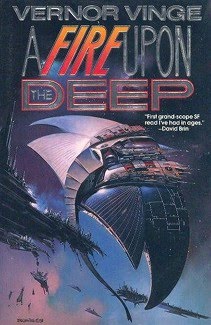
1993 Hugo (tie) – A FIRE UPON THE DEEP by Vernor Vinge


I have to say that this tie makes a lot more sense to me than the previous Hugo tie (the legendary Dune and the not-so-legendary Call Me Conrad). In 1993 we have two very different books that are both well-written explorations of classic sf themes. Both have entered the sf canon and influenced subsequent works. Willis gave us medieval human suffering via time travel. Vinge gives us similar levels of human suffering via singularity-ridden space opera.

Ah, yes, the “singularity.” I mentioned it briefly in my 2010 Hugo reviews, and I’ll probably be talking about it a lot more often from here on, in part because of the influence of Vinge. Basically, you mix together Moore’s Law and Clarke’s Laws, extrapolate a bit, and you get the idea that technology will eventually accelerate off the charts.

A Fire Upon the Deep takes place in the distant future. The Milky Way galaxy can be divided into “Zones of Thought.” Near the core are the “Unthinking Depths” where technology doesn’t work, but higher and higher technology exists the farther you get from the core. At the edge, you have “the Beyond” where post-singularity higher beings romp around. The middle “Slow Zone” allows species like humans to evolve and develop technology protected from rampaging, post-singularity “Powers.” At the beginning of the novel, a group of humans at a research base called Straumli Realm accidentally awake a particularly malevolent Power called the Blight. A small group of researchers, mostly children, escape to the medieval Tines’ World. A pair of humans, Ravna Bergsndot and the ancient, formerly dead Pham Nuwen, journey to rescue the children and try to find ammunition against the rampaging Blight.

A lot of attention is given to the Tines themselves. They’re dog-like quadrupeds, and individually, they’re basically animals. But they can communicate telepathically (or subvocally) and form small hive minds that are intelligent. This set-up allows Vinge to create a very interesting culture, especially with their technological limitations.

Big Ideas abound, and they are, on the whole, pretty darn cool. The book is not as strong on character, pacing or prose though. I didn’t care about Ravna, Pham, or the kids (and the use of the latter seemed a bit manipulative), though there were a few Tines I liked. The middle of the book drags as we get extended, and repetitive, scenes, involving a starship chase and Tine politics. The writing is fairly pedestrian; it gets the job done, but that's about it.

An even bigger problem is accessibility. When I mentioned this whole Hugo project to my local sf bookstore owner, he responded “that’s good; those books all talk to each other.” By this point, reading a book like A Fire Upon the Deep really does feel like coming into the middle of a conversation, picking up where Brin’s Uplift books left off, in this case. My fellow Hugo-reviewer Josh Wimmer started out his project asking if science fiction deserves its ghetto…this novel might suggest that it does. I really, really enjoyed Vinge’s novel, and I especially love the ideas, but can I really consider a novel great if I can’t recommend it to a non-sf-reading friend? That’s an intriguing question to me, and I’m interested to see how this problem develops throughout the ‘90s and if it explains the Hugos’ abandonment of traditional sf in the ‘00s…

Grade: A-

Wednesday, August 25, 2010

2010 Hugo nominee, novella: "Vishnu at the Cat Circus" by Ian McDonald (CYBERABAD DAYS))


This novella is part of the short story collection Cyberabad Days, which recently received a special citation from the Philip K. Dick awards and takes place in the same world as McDonald’s award-winning River of Gods (which is on the docket for future review). All of these stories take place in a divided India in the middle of the twenty-first century. Nanotech and genetic engineering are common, especially among the middle and upper class, and there are also powerful sentient computers, called “aeais” – basically, this future India is on the verge of a “singularity.”

This novella follows the titular Vishnu, a genetically engineered boy. A “brahmin,” Vishnu is super-intelligent and destined to live twice as long as a normal human. Unfortunately, he also ages at half the rate. In his teens, he’s a sexually confused prepubescent. In his twenties, he’s become an influential figure while still an adolescent. To add insult to injury, technology makes him obsolete before he reaches adulthood.

It’s a chilling depiction of genetic manipulation, and it also depicts a very rich world. It’s an incredibly dense work, with political, social, and technological changes introduced on every page. I have doubts that the world will change that much in my lifetime, and this is going to be a common complaint with me and stories about “singularity.” But, I’m willing to go with it, and McDonald’s focus on the developing world, quite well-realized, adds a welcome twist.

I got the impression that Vishnu was a new character but that his story was heavily integrated with material from River of Gods (I guess I’ll know for sure when I get to that novel, probably next year). As a preview for that novel, however, this novella certainly had me intrigued. I’ve complained in the past that short fiction leaves me wanting more; in this case, it’s nice to know that there actually is more. I’m not sure how well this novella stands on its own though.

Grade: B-

Tuesday, August 10, 2010

2010 Hugo nominee, novelette: "The Island" by Peter Watts (The New Space Opera 2)

Peter Watts packs a lot into this short piece of fiction, which was part of one of the “New Space Opera” anthologies that are supposed to highlight the new directions the genre has taken away from its traditional Star Trekkish roots.

It is different. The narrator is a woman named Sunday who lives and works on a ship named Eriophora over a billion years in the future. The ship is tasked with building wormholes to facilitate interstellar travel for the various posthumans zipping around the universe. It’s not a job that the crew can quit, and they seem to be immortal. It’s also a fairly thankless job – no one bothers to communicate with them. The crew resents the work, and especially their boss, a computer they call Chimp, but they toil on for eternity. Watts manages to get all of that world-building in, plus a fairly significant plot. The narrator meets a new worker named Dix who claims to be her son but acts a little odd, and the crew encounters a massive alien entity floating through space (the titular “Island.”) So, for all the high-concept post-singularity complexity of the world, it’s really a story about reaching out to other beings and making connections amidst an isolated and hostile situation (the title’s other meaning).

I liked it. It’s well written, and the emotional themes do resonate. At the same time, the world seems needlessly complex to me. The real story is about Sunday and Dix, and we don’t really need the wild setting to get them to the interesting emotional place we see them in. Watts seems to be showing off a bit with the world-building. There’s some interesting material in there, but I worry that these far future post-singularity settings are going to start to feel generic to me by the time I catch up to the present on my Hugo reading.

Grade: B-