Showing posts with label aliens. Show all posts

Friday, May 25, 2012

2012 Hugo nominee, novel: EMBASSYTOWN by China Mieville


Mieville has obviously made plenty of waves in the past decade, and I have to admit that his books are consistently very good, even if only one has really clicked with me.  As much as the Hugos have turned towards fantasy over that same time period, I still think there’s a slight preference for science fiction among WorldCon voters…or at least a reserve of feeling that science fiction should be competing better against fantasy. So, when a hot author like Mieville turns toward space opera for the first time,* and gets some great reviews in the process, I think you have a very strong contender not only for a Hugo nomination, but for a win.

The novel takes place on the planet Arieka, a distant outpost of Bremen, a human (or “Terre”)-dominated stellar empire. The Ariekei are non-humanoid aliens with very different physiognomies that breathe a different atmospheric composition, and, most importantly, they have a very literal language that makes their cognition entirely different from other species. In other words, it’s a more likely portrayal of aliens than your typical Star Trek races, and one that takes us back to the linguistic Sapir-Whorf hypothesis that we saw back in Babel-17. The Bremen colony on Arieka is a smallish outpost called Embassytown, whose residents see the Ariekei as strange, somewhat frightening, Hosts.

Avice Benner Cho grows up in Embassytown, but learns that she has a talent for the “immer” that makes interstellar travel possible. She leaves Arieka and gets to see the universe, but she is eventually drawn back home with her linguist husband Scile, who wants to learn more about the Ariekei. We also learn a great deal about the Ambassadors, the only people really capable of communicating with the Ariekei. This requires a pair of twins linked through surgery and training. Avice is friends with Ambassadors named CalVin, but she also witnesses the arrival of a new Ambassador named EzRa, who inadvertently rocks Embassytown to its core.

The ideas are fantastic, as you’d expect with Mieville, but I also had some of my other typical Mieville complaints. The characters are all pretty flat, serving either to forward the plot or convey exposition and/or ideology. Mieville’s plots also all seem to follow the same trajectory: he sets up a society, shows its precariousness, and then tests it with a revolution (I wonder if Mieville is stuck in this revolutionary rut because he’s a Marxist).  I would like to see something different from him. The structure of the novel also seems needlessly flashy with a non-linear narrative that serves little purpose (and accordingly gets dropped after about a hundred pages).

So, my verdict seems to follow what I say about most Mieville novels (other than maybe The City & The City). It’s a well-written work with incredible ideas that could have worked better with more character and plot development. Honestly, this might have grabbed me more as a novella that simply established the world – I think such a work could have been a true classic. But, it’s a rare thing in this day and age to see a space opera this original and well-written that captivates mainstream literary circles and makes bestseller lists all over the place. As such, I expect it to do very well in the voting this year.

Grade: B


*I’d argue that The City & The City is actually a science fiction novel rather than a fantasy novel, which makes the 2010 Locus awards look rather silly (The City & The City won Fantasy, while magic-steampunk-Old-West-zombie-gas novel Boneshaker won as “SF”)

Monday, March 26, 2012

1948 – DIVIDE AND RULE by L. Sprague de Camp


Where has L. Sprague de Camp been all my life? I vaguely knew the name, but I’d never read a word he’d written. About a year ago, I head a description of this book and though it sounded worth checking out (which is why I’m starting here rather than the obvious Lest Darkness Fall).

“Divide and Rule” is a short novel/long novella from 1939 about a future in which humanity has been conquered by giant rabbit aliens that everyone calls “hoppers.” They landed in South America and waged a long war of conquest (aided by epidemic alien disease in a very nice historical touch). Once they were finished they took action to suppress humanity so that it could serve as their labor force; they outlawed industrial technology and forced schools to teach that they were gods in the natural order. Most importantly, they decided to divide humanity (we have a title!) by imposing a new feudal order.

A couple of centuries later, Sir Howard van Slyck, the Duke of Poughkeepsie, has spent most of his young life raiding castles and fighting duels across New York. He meets a chain-mailed, whip-wielding commoner from the west named Lyman Haas. Haas and van Slyck team up to rescue a damsel-in-distress named Sally Mitten but earn the enmity of the hoppers in the process. Sally leads them to the resistance in hiding, and they learn the truth about their world.

It’s a fast-moving, fun adventure story with good characters, snappy dialogue, a strong concept, and some interesting sf ideas. The only flaw is that the hoppers have some very convenient weaknesses that allow the story to wrap up quickly. I really wouldn’t mind more of this story.

The bigger flaw with this product is that “Divide and Rule” was paired with a much weaker story called “The Stolen Dormouse” to fill out the book’s length. It’s not a bad story, and there is a thematic link – it’s another feudal order. This time, corporations become so powerful that they evolve into feudal states with inherited ranks. It’s an interesting idea and one that’s been fairly persistent in sf, but de Camp uses this setting first to do a Romeo and Juliet pastiche, then adds some slapstick action. Hawaiians get to play a fun role though, and de Camp throws in some decent sf concepts that were probably fairly new in 1941 – the titular “dormouse” is a person in a hibernation chamber and a few bioengineering ideas get thrown around. It’s short, clever, and funny, but not nearly as strong as “Divide and Rule.”

I will definitely be revisiting de Camp in the future. He checks a lot of sf boxes for me – he likes history and uses it to inform his speculative fiction, he’s a rationalist, he likes to mix comedy and adventure, and he’s fairly progressive on gender and racial issues…at least for someone writing in the late ‘30s. This was a great surprise.

Grade: A- (though that ignores “The Stolen Dormouse”).

Tuesday, January 31, 2012

2008 Hugo for Dramatic Presentation, Short Form – “Blink,” DOCTOR WHO


Another year, another Steven Moffat Doctor Who script win in this category.  That’s three in a row.
With each season the cast and crew seem to get more confident and self-assured, and Tennant has settled into the role wonderfully; he’s the favorite of many Who fans, both new and old. The Doctor also has a new companion, a young medical doctor named Martha Jones, who I prefer to Rose in almost every way. She has a crush on the Doctor, which maybe isn’t quite as interesting as the mutual attraction with Rose, but it seems to suit the dynamic of the show better and the actress who plays Martha, Freema Agyeman, is far more charismatic and talented (and attractive, for that matter) than Billie Piper. She’s great. In my opinion, the two nominated storylines of season three are two of the best Doctor Who stories ever.

So, things keep getting better all around. *Most* of this season is darn near perfect. The Doctor and Martha meet-cute with alien rhinos on the Moon in “Smith and Jones,” there’s a fun spaceship hurtling towards the sun suspense story in near-real time called “42,” and I have an unreasonable affection for the first Doctor Who episode I ever saw, “Gridlock,” which is about a decades-long flying-car traffic jam on a distant future colony of Earth. Even some of the throw-away stories like “Lazarus Man” and “The Shakespeare Code” are miles ahead of some of the lame season two episodes, though a Dalek two-parter in Depression-era Manhattan is appallingly bad. And then there’s the “whonimees,” which appeared back-to-back in the second half of the seasons:

“Suddenly Human”/”The Family of Blood” – Another Paul Cornell story with good focus on character, this time the Doctor, though Martha gets several good moments as well. To hide from evil aliens called the Family of Blood, the Doctor disguises himself as a human at a British boarding school in 1913. Even the Doctor can’t know his real identity, but his pseudonymous John Smith personality falls in love with the school’s matron, making for a tough decision when the Family attacks and Martha feels that she needs to return the Doctor’s true identity. The Doctor’s love story is interesting, the show plays with some issues of class, gender, and race with the disguised Martha, World War I hangs in the background of the story in some brilliant ways, and the last few moments are brilliant.

“Blink” – Steven Moffat knocks it out of the park with one of the greatest hours in science fiction television history. Maybe I’m overhyping it, but it is universally beloved. The villain is creepy (though it doesn’t always entirely make sense), and there’s a fun "timey-wimey" plot. The Doctor isn’t actually in the episode all that much, but Academy Award-nominated guest star Carey Mulligan carries the show fantastically.

Following these episodes, the Doctor and Martha go trillions of years to the future in “Utopia,” a creepy episode with a great cliffhanger reveal.  Then…we go into a not-so-great finale where Russell T. Davies’ one-upsmanship gets out of control and things get pretty rough.  But, take out that Dalek two-parter and replace the finale two-parter with something that makes more sense and hangs less on clapping for Tinkerbell, and it would’ve been a perfect season.

Season 4, by the way, is even more consistent in that it has even fewer dud episodes, but also fewer truly great ones. Of course, the Steven Moffat two-parter “Silence in the Library/Forest of the Dead” is great. It’s nominated next year, but it did lose (for once).

Grades: “Suddenly Human”/”The Family of Blood”  A
“Blink”   A
Season  A-

Wednesday, December 14, 2011

2006 Nebula - SEEKER by Jack McDevitt


It says a lot that I often feel obligated to explore the motives of the SFWA committee that chooses the Nebula winner. In this case, we have a novel that’s about as standard as could be, and I’m tempted to say that the SFWA is rewarding an older author for being a good member of the community…

Seeker is the third novel following the adventures of daring space archaeologist Alex Benedict.  It's narrated by his assistant, interstellar pilot Chase Kopath (I'm not sure if she narrates the other novels or not).  Alex and Chase are space archaeologists and artifact dealers.  They discover a plastic cup that may be a relic of a 9000 year old lost colony, and Chase has to follow a number of leads to track the cup back to its origin - the colony ship Seeker.  If Alex and Chase can find the colony, they'll make a fortune, but along the way they must contend with rival archaeologists, the family of the survey team that found the cup and hid it existence, the brutish robber who last possessed the cup, and the telepathic alien "mutes" who unwittingly have a important clue.

From top to bottom, this novel just screams genre.  There's the simple, propulsive prose with some noir stylings.  There's the formulaic, linear plot, in which each encounter yields a clue that advances the investigation.  There are the required action scenes, that exist for no particular plot reasons.  There are mysterious sub-plots, and even over-the-top villains, whose violent tendencies clash a bit with their staid occupations and idealistic aims.  The setting is simple but rich with possibilities for action and mystery stories; just take an interstellar republic 10,000 years or so in the future, add simple faster-the-light travel, and stir in an alien race and lots of artifacts. It's really right out of the golden age.  And, you've seen all of the plot elements before too.  It's genre fiction through and through.

And, there's nothing wrong with that.  The plot is interesting enough (though maybe a bit too predictable), and who doesn’t enjoy the archaeologist-adventurer character?  And, it’s got a great structure, where each episode in the plot moves the mystery forward and adds a new hook. On the other hand, the characters are dull as bricks.  Alex is a cipher here, Chase is generic, the villains are awful and inexplicable, and the ancillary characters are straight out of the stock genre file. There isn’t much in the way of ideas either.  We get some discussion of Earth’s dicey political fate over the millennia to come, and the utopianism of the lost colony adds a little spice.  Meanwhile, we also get some simplistic demonization of cultural protection movements in the artifact trade…which seems like a big fight to pick in an adventure novel.  

All in all, I was entertained, but I’ve come to expect more from these award winners.  This might have felt newer sometime before Gateway…but that was thirty years earlier.  I had some issues with Spin, but it’s operating on a whole other level.  The Nebula slate this year (which is, unusually, completely different from the Hugo slate) looks pretty thin anyway, so I guess I'm glad McDevitt got the recognition.

Grade: B-

Sunday, November 27, 2011

2005 Nebula – CAMOUFLAGE by Joe Haldeman


An extremely resilient, shapeshifting, immortal alien evolves in a harsh interstellar environment then travels to Earth.  30,000 years ago, it landed and began to observe local life, living for thousands of years as a shark.  Finally, in 1931 it comes ashore and takes human form.  We follow this “changeling” over the following decades, as it takes many different human forms and comes to understand human emotions.  The great cornball sci-fi question, “what is love?” is actually uttered several times in the novel, though at least Haldeman has the good sense to couch it in literary allusions.  While we follow the changeling's history through the years, we also see the excavation of its ship in 2020, led by Russell Sutton, the man who raised the Titanic.

I can’t say that I didn’t enjoy this book.  Maybe it’s my love of history, but I’m a sucker for the “immortal experiences key events beyond a single lifespan” gimmick.  Haldeman is as good as anyone at depicting war from the soldier’s point of view, and there’s a very effective section on the Bataan Death March in the Phillippines during WWII.  That said, we’ve seen this before.  In fact, in this age of vampire dominance, we’ve seen it a lot.  I’m also a sucker for the “team of scientists try to understand unfathomable alien artifact” gimmick, which takes up most of the rest of the novel.  Again, we’ve seen it before, and we’ve seen it done better, but combining two basic plots I enjoy is probably not the recipe for a novel I’m going to hate.

It’s not necessarily the recipe for a novel that I’m going to love though.  The novel starts by combing some tried-and-true formulas, but it does go off on some tangents towards the end.  There’s an odd, and rather forced, love story.  Haldeman introduces another, unrelated, alien called the “Chameleon,” and I know he’s trying to draw a contrast between different views of humanity, but it really just feels like the Chameleon is just there so that there can be a fight at the novel’s climax.  There are extended descriptions of the elaborate lengths the Changeling has to go through to establish identities in the modern world. And, there’s a big twist that is so obvious that I was sure Haldeman was going for a fake out.

It’s a mildly entertaining, but flawed, novel.  It certainly doesn’t feel like an award-winner.  I think it’s fair to hold all of these award-winners up to a high standard, and to expect them to have high quality writing and bring new ideas or themes to the table; this one does not measure up.  This is Haldeman’s third Nebula.  Forever War is a classic in the core sf canon.  Forever Peace has some major issues, but it’s asking big questions and has some new ideas.  Camouflage is a workmanlike, derivative sf thriller.  Once again, I have no idea where the SFWA is coming from.

Grade: C+

Tuesday, July 26, 2011

2011 Not a Hugo Nominee - MONSTERS


Monsters didn’t get much of a theatrical release, but it did garner some strong reviews and comparisons to other recent “indie” sci-fi movies like Moon, and especially District 9. Like the latter movie, Monsters maps an alien encounter onto familiar political issues. Because of solid character work, I found it a lot more engaging than District 9, or the other big cinéma-vérité-monster-movie Cloverfield.

Mexico has been infected with alien lifeforms that can poison organisms on Earth and grow into giant monsters. The US has attempted to contain the creatures in Mexico, fencing off a giant “infected zone” in northern Mexico and conduction air raids throughout the country, making it into an alien warzone. Samantha (Whitney Able) is the daughter of a big-time newspaper magnate, and she has somehow washed up in Central Mexico. Her father charges a photographer named Kaulder (Scott McNairy) with getting her back to the safety of the United States. He’s unenthusiastic, though he does have the hots for Samantha; he also botches the transport, which forces them to take a dangerous path through the infected zone.

Most of the film consists of understated interactions between Kaulder and Samantha, but these scenes work really well. Writer/director Gareth Edwards* does great work with the dialogue, and the acting from the two unknown leads is quite good. They don’t fall into instantaneous Hollywood love, but they are drawn to each other, and into danger, by a mutual dislike of the lives they’re living. The film is focused entirely on these two characters, and their relationship, and it works. We’re not stuck with the yuppie douchebags of Cloverfield or the human walking disaster that is Wickus in Dictrict 9, but the characters aren’t perfect either. Edwards also makes great use of his Latin American locations, and he frames his characters in some really beautiful shots, though the geography is screwy (where exactly is that tropical Mayan temple on the US border? I’d love to visit it). The people of war torn Mexico also get a voice in several small roles that round off the world quite nicely and subtly.

The monsters don’t do much. They help to set the scene, that’s for certain, and I actually like the way they’re used as background material for almost the entire movie. You know that they have to make some climactic appearance though, and the scene where they do feels tacked on and unnecessary. Also, while I give the movie credit for being subtler (and far less misanthropic) than District 9, I’m not sure that the metaphor does come through clearly. Does the monstrous alien infection represent the drug wars that are ripping though northern Mexico and threatening to spill into the United States? I think so, though the movie doesn’t seem to have much to say about them other than they’re really bad. Maybe we’re supposed to focus on the callous way the American military operates across the border? Maybe. This movie should be all about the border, the line that shapes the two nations’ relationship and the lives of the people that live along it – it’s the characters main objective, but not much else is said about it. Also, a Mexican character with a bigger role sure would have been nice.

Still, it’s solid, character-driven filmmaking. It was quite good at being what it was, even if it could have done more with its sf metaphor. I'm not too sorry to see the nominators skip it, but it might have been a nice addition to the field if, say, we'd waited to nominate the complete Deathly Hallows next year.

Grade: B+


*maybe I should mention that this is a British production, but, I’ve never met an American named Gareth so maybe it’s obvious

Friday, June 24, 2011

2011 Hugo Nominee: Novelette - "That Leviathan, Whom Thou Hast Made" by Eric James Stone (Analog, September 2010)

This is another sort of old-fashioned space opera story. We even get exposition describing simple elements of the world from a first person narrator, which most authors seem to bend over backwards to avoid these days. I’m fine with this; I’ve always found being forced to puzzle out the ground rules more distracting than the illogic of a person describing what should be a familiar environment.

Harry Malan leads a branch of the Church of Latter Day Saints on the sun. Most of his congregation is made up of “swales,” alien beings that live in stars and build star gates between them. Malan has conflicts with local scientists studying the swales, especially Juanita Merced, whom he also happens to have a crush on. He comes into conflict with the swale elders when the mores of the church begin to conflict with swale culture. The story raises some interesting ethical issues, and it presents a simple but fun space opera world, something that I feel has been missing of late.

This is clearly from Malan’s perspective, and Stone is also LDS, but I (decidedly not a Mormon) usually found the presentation balanced. A lot of the reaction from other reviewers whose blogs I follow has been intensely negative. I think you could view this story as a manipulative justification of missionary work. As a historian, I’ve done a great deal of work on the Franciscan missions of California and the Protestant mission in Hawai’i, and both cases are fraught with violence, sexual repression, and appalling death rates. I’d be one of the last people to defend missionary work as a general principle, but I do think the story gets more complex when you bring it up to the present. In the modern world, there are clear points of conflict between universal humanist values and respect for cultural diversity. Religion, of course, complicates these conflicts, and in this story, so does the fact that the other culture is non-human. All of this makes for a fascinating read. What’s really missing here, and what undermines the metaphor to a large extent, are the power dynamics that are usually present in missionary work. Malan is often in danger from powerful alien beings. Historically, missionaries were also often in danger, and many were killed, but missionaries were almost always backed by some sort of imperial power, and disproportionately violent retribution often followed martyrdom. It's almost always been more dangerous to be the object of missionary work than to be a missionary. If Stone really wanted to explore these dynamics, his swales should have been more vulnerable.

Still, I really enjoyed this story. It doesn’t reinvent the wheel, and it’s not shooting for a PEN/Faulkner award, it just presents an interesting concept in a simple, entertaining way. I see why some people were offended, but I did think it had a lot more nuance and evenhandedness than, say, Speaker for the Dead (which makes me a little bit angrier every time I think about it).

Grade: B+

Thursday, June 9, 2011

2011 Hugo Nominee: Short Story - "The Things" by Peter Watts (Clarkesworld, January 2010)

So, we’re nominating fan-fiction now, huh?

I’m just kidding. Well, mostly. Watts’ “The Things” is a retelling of John Carpenter’s 1984 film The Thing, and it follows the film very closely (it’s on Netflix streaming, and I actually stopped reading and watched it as soon as I realized what Watts was up to). The twist is that Watts is telling the story from the perspective of the creature. It turns out that the titular Thing just wanted to talk, but its method of talking involves splattering Carpenteresque gore all over the place, a process it calls “communion.” It’s an interesting twist, and yet it felt somewhat familiar, even if I can’t pinpoint exactly from where. For most of the story, it felt like the old “the monster is us!” canard. The story does save itself towards the end by questioning the basic nature of life on Earth – what if all the things we take for granted about biology are unique to our planet? What if death and individuality are cosmic aberrations…even errors? I enjoyed those questions, but they came too late to save the story for me. I’ve also decided that I’m not a big fan of Watts’ dense, chewy prose. It’s certainly not bad, and I give him credit for having more of a voice than many sf writers, but it’s not really my cup of tea.

I know this is everyone else's story of the year, but it wasn't mine. I enjoyed the movie a lot though. I don't think I'd ever seen it before (though I had seen the also great Howard Hawkes version).

Grade: B-

Monday, May 16, 2011

2000 Hugo and Campbell – A DEEPNESS IN THE SKY by Vernor Vinge


It’s a good thing that I’d built and increased the lead time in my reading for this blog, because the whole project came grinding to an awkward halt for about a month when this book came up on the list. For the past few years, I’ve been in a groove where I read a novel or two every week, and that includes some eight-hundred pagers…but this one stopped me cold for some reason.

Some reason? I actually know the exact reason. This novel may look like a svelt 800 page novelette, but there’s about 10,000 pages of story in those 800 pages, and a lot of it, frankly, ain’t that interesting. In fact, between A Fire Upon the Deep and this novel, I can see a clear pattern in how I react to Vinge’s books: Phase 1) initial interest in the Big Ideas presented, along with a little confusion as I get my bearings. Phase 2) a long slog through the middle as everything bogs down in jargon and the characters plot and plot and plot, stop to plot a little, then plot some more. Phase 3) a jumbo exciting climax and generally satisfying dénouement. So, I come out liking about 2/3rds of Vinge’s novels, and in A Fire Upon the Deep it worked out fine. In Deepness, however, that middle third took up a solid 9000 of the aforementioned 10,000 pages. It was a slog.

Deepness takes place 20,000 years before A Fire Upon the Deep in the same “Zones of Thought”-verse, though the Zones don’t actually come up much. Humanity hasn’t met many aliens, and they just chug around in slower-than-light sleeper ships. There’s a large group of freedom-loving space capitalist traders named the Qeng Ho who swashbuckle around space (they’re mentioned often in Fire). They’ve found a crazy star that periodically shuts down, which they call OnOff. That’s mysterious enough, but when they learn that it’s inhabited, they have to check it out. Another group of humans, called Emergents, also hear alien transmissions, and the race is on. The Qeng Ho and Emergents work together for about five pages, but the Emergents ambush the Qeng Ho with a virus called "focus" that turns people into obedient computing machines. Meanwhile, we also begin to learn about the spider-like aliens on OnOff’s planet, who are undergoing their own version of Earth’s twentieth century (these are actually the best scenes in the drudgery of “phase 2”). I’d mention some characters, but they’re all super-brilliant heroic/evil generic plotters, and there’s a minor spoiler about the main character.

I’m actually fairly excited about the summary I just wrote, and I wish I could remember this novel more fondly. There are plenty of interesting Ideas, half of which I haven’t even mentioned, and some intriguing twists at the end. But, that middle portion of the book just killed my brain. From the time the Emergents attack to the final confrontation is so repetitive, hopeless, and dull that I often put the book down for days at a time. I had zero connection with the characters, and there are several large time skips in the novel that really put me off. The whole thing takes place over several decades (I mean MegaSeconds…don’t even get me started on the metric time scale), and we’ll check in on a character after five years and find that NOTHING HAS CHANGED because they’re all SO DAMN BORING. This, of course, only increases the distance I felt from them.

It’s a rich book with wonderful ideas and some memorable moments. I tend to like this sort of ambitious, epic space opera, but I can’t really recommend this one, and I have to admit that I struggled to relate to it. I hope Vinge’s third Hugo-winner is shorter.

Grade: B-

Tuesday, April 19, 2011

1998 Clarke and 1997 BSFA – THE SPARROW by Mary Doria Russell


There’s an oft-heard cry among fans of science fiction novels – “when will mainstream literature accept us?” I think there’s a legitimate beef there, but I also think it’s interesting that the science fiction establishment is quick to reject a science fiction novel from an sf-outsider that *is* quickly accepted by much of the literary mainstream. This book, a first novel, is a good example – since its release it’s been a mainstay of “literature” shelves in bookstores and it’s made the circuit of mainstream book clubs. And, it’s quite good. Yet, it did not get as much attention from sf circles. Russell won a Hugo for best new writer, and she got the BSFA, but this novel didn’t receive a Hugo or Nebula nomination. Its biggest win was the Clarke, which already had a reputation for favoring mainstream writers since its first presentation to Margaret Atwood. Maybe I’m exaggerating, but sometimes I do feel like the lack of communication goes both ways.

The novel follows a Jesuit priest named Emilio Sandoz who returns from a church-sponsored first contact mission in disgrace in 2059. We then flash back to the discovery of the aliens in 2019 (who broadcast beautiful songs over radio waves from just a few light years away), and the assembly of Sandoz’s first contact team, which comes to include other priests, an elderly couple who are close friends of Sandoz, and a beautiful AI programmer with whom Sandoz is smitten, despite his vow of chastity. They travel in a retrofitted asteroid to the planet of Rakhat and meet the planet’s two sentient species, the pastoral Runa and the more sophisticated Jana’ata. Meanwhile, in “present day” sections we see Sandoz on trial, and we learn just how horribly wrong everything went on Rakhat.

The Sparrow’s sf credentials should not be in doubt. In fact, the proceedings feel pretty retro. The religious themes are clearly reminiscent of Blish’s A Case of Conscious, the first contact scenario and space travel have a few elements of Clarke, and the attention to the ethnographic detail of the aliens is straight out of LeGuin. Russell handles all of this elements with great skill, and overall, her prose is pleasant and readable. And she shines with her handling of the characters, especially Sandoz and the considerable development of his faith throughout the novel. I’m not a religious person, but I found the priest’s religious struggles moving and intellectually satisfying.

I’d say the novel’s one major flaw is in its pacing. The early chapters unfold very slowly, and it takes more than half of the novel to get Sandoz to Rakhat. Russell lays down some important character groundwork in these chapters, but she also treads some water. The final chapters unfold very quickly, and some very important events get only brief overviews during the trial.

SF fans might complain, and they wouldn’t be entirely wrong, that this novel doesn’t really cover any new ground, but I don’t think every novel needs to have a Vingean “New Idea.” In fact, I’m beginning to think that obsession with Ideas is the central problem with modern sf. I prefer the sort of grounded character work presented here. Forever Peace has more flashes of brilliance, but this is a better novel, taken as a whole.

Grade: A-

Wednesday, April 13, 2011

1997 Saturn – MEN IN BLACK


The Saturn is far from the most prestigious award that I’m covering, but I wanted to include it for the sake of variety in my movie reviews. It has also awarded some very strong films that outshined their more prestigious Hugo competitors in the long-run (Soylent Green over Sleeper, Terminator over 2010, 12 Monkeys over Babylon 5). So, the Saturn has recognized its fair share of strong sf movies. This is not one of them.

Men in Black is a big-budget science fiction action comedy special effects extravaganza. There’s also some sort of story and characters in there, but they’re mostly overwhelmed by a combination of slime jokes and cg goo aliens. The film, adapted from an obscure Marvel comic book whose existence I cannot verify, taps into the alien conspiracy craze that the super-popular X-Files had rekindled at this point while adding lots of elements from the aesthetics of Steven Spielberg and Tim Burton (Spielberg executive produced, though director Barry Sonnenfeld seems more indebted to Burton on this one). The men in black are mysterious well-dressed government agents who cover up alien encounters. Tommy Lee Jones plays an uber-professional man in black, basically by reprising his role from The Fugitive. Will Smith plays the headstrong new recruit in a set up that is only slightly incredibly generic. Rip Torn is the bossy boss. Linda Fiorentino is underused as the love interest. Tony Shaloub and others play weird aliens, just barely passing as humans. I think I’m listing the cast because there’s so little plot to recount. Aliens threaten to blow up the world, and the Jones/Smith team must stop them. The film undercuts itself by repeatedly reiterating that the plot may seem exciting, but this is really just a normal, boring day at the office for the men in black.

If you haven’t noticed by now, I’m not a fan of this movie. It’s quite popular among lots of sf fans, but it rubbed me the wrong way the first time I saw it, and it rubbed me the wrong way again this time. Jones could pull this roll off in his sleep (and, he may actually be sleeping through most of the movie – what are those sunglass hiding?), and Will Smith is his usual, sickeningly charismatic self. They’re the best things about this mostly stupid film. There’s a fair amount of childish gross-out humor, which is generally not my favorite, and the rest of the jokes depend on the idea that anyone at all unusual must be an alien.* “New Yorkers sure are weirdos, they must be aliens!” Har…har? I don’t want to seem oversensitive; a smarter script could probably make these things work. This is not a smart script.

So, yeah, not funny. Not even a good riff on the alien conspiracy idea. The best thing I can say about this film is that it’s very short and quite inoffensive…and yet, I am offended by its inoffensiveness. Sorry, I think I have an irrational hatred for this film. The fact that it won in a good year for sf-on-film over the likes of Gattaca, Contact, and The Fifth Element just makes me even more annoyed.

The sequel, by the way, makes this movie look like The Godfather II.

Grade: C-


*By the logic of the film, shouldn’t Rip Torn be an alien rather than a man in black?

Wednesday, March 30, 2011

1996 Saturn – Independence Day (ID4)


I'm posting today rather than Friday for personal scheduling reasons, but also to clearly avoid the many-tentacled hellbeast that April Fools on the internet has become. I mean, this is a review of ID4! I have to give it the proper reverence that it deserves!

With our second Emmerich movie, a smash summer hit, I think we’ve officially entered the second generation of the blockbuster. We’ve seen many of the best entries from the first, dominated by Lucas and especially Steven Spielberg. Emmerich and Producer Jerry Bruckheimer dominate the second: the films are bigger, even more special-effects-driven, more jingoistic, and, well, stupider.* That doesn’t mean they can’t be fun though….they just usually aren’t.

ID4, most of all, walks the tightrope between stupid and fun. Even watching it again for this blog, for the first time in at least a decade, I couldn’t quite decide if it was too stupid to be fun or too fun to worry about its stupidity. I kept swinging between those two options.

Basically, this is a rewriting of War of the Worlds to give it more patriotic Fourth-of-July action. Alien ships come down from the sky, and everyone is happy to see them. But, eccentric scientist Jeff Goldblum thinks the aliens plan an attack, and he rushes to tell President Bill Pullman (if the characters have names, I sure don’t remember them – that kind of character detail isn’t important… explosions!). The aliens promptly do shoot green beams that annihilate the White House, the Empire State Building, Big Ben, the Eiffel Tower, etc., and the film’s characters take to wandering around Area 51, looking for a dues ex machina, which they promptly find and use, after the requisite number of UFO vs. jets dogfights. Even the President gets to fly a fighter after a fairly lame inspirational speech. Along the way we get lots of homages to that first generation of blockbusters, especially Close Encounters and Star Wars.

I should also add that this begins the era of Will Smith. Around this time, Congress passed a law requiring that all dominant summer blockbusters contain the Fresh Prince. This act was eventually repealed in one of the most controversial provisions of the Patriot Act, and everyone who had to sit through Smith’s various failed Oscar-bids, like 27 Pounds, laments the law’s end. How much better would Transformers have been with Will Smith’s unflappable charisma? I’m only partially kidding, as it is the easy charm of Smith, Pullman, and Goldblum that helps make the film bearable. On the other hand, Randy Quaid’s groan-inducing turn as an alcoholic Vietnam vet who pulls-it-together to save-the-day does not help. No wonder the star whackers are after him.

In the end, I’d say that the fun won out over the stupidity, but I’d add the caveat that the film (by which I mean the effects that the film leans so heavily on) has not aged well, and watching it today, the stupidity is even more evident.


*I’ll take any Emmerich film over almost any Bruckheimer film…except maybe Pirates of the Caribbean and The Rock.

Grade: C+


Thursday, March 17, 2011

1996 Hugo for Dramatic Presentation – “The Coming of Shadows,” Babylon 5


My teenage sf-nerdom didn’t really tail off until ’97, so it’s a bit of a surprise that I didn’t give more attention to this critical darling of sf fandom. To this day, there’s a fairly significant group who consider this the best science fiction show of all time. Back in the day, I watched the tv movie and the pilot, and maybe one or two other episodes…and I really didn’t enjoy what I saw. Now, I’m working my way through the whole series (thanks Netflix Instant Viewing!) and I can see exactly why I didn’t like it. However, just maybe, with this episode, I’m starting to see why it’s so beloved.

The overall series takes place in a space opera setting dominated by races which are often at each others’ throats. The plume-haired Centauri are the old colonial overlords of the spot-headed Narn, and humans have recently fought a long, losing war with the mystical bald-headed Minbari. And then there are the mysterious Vorlons, whom few have ever seen because they wear bulky atmosphere suits. In an attempt to establish galactic peace, these five races have created a sort of League of Nations dispute-resolving body that meets on a human-controlled space station called Babylon 5. However, this Alliance is highly controversial, and the first four Babylon stations came to bad ends.

The show is the brainchild of J. Michael Straczynski , who wrote an overwhelming number of the series’ episodes himself and came in with a detailed plan of its overall arcs. The heavy foreshadowing and intricate maneuvers that JMS’s plan made possible are what really sets the show apart from others. “The Coming of Shadows,” an episode from the second season, is one of several turning points that progresses the multi-season arc in some major ways. A mysterious force known as the Shadows has been manipulating some of the characters since season one, and here it provokes an all out war between two Alliance members – the Narn and the Centauri – as the Centauri emperor dies. In a sub-plot, B5’s former Commander (from season one) sends a message that he is preparing a resistance to fight in the dark times that are to come. The fact that the show would change its lead for the second season (Bruce Boxleitner comes in and does a decent job) is another example of its boldness.

In other words, it’s an episode that plays to the show’s two biggest strengths – intricate long-term plotting and the aliens’ diplomatic intrigues. At a time when serialized television was virtually non-existent, Babylon 5 rewarded careful viewing in ways that influenced Buffy, Lost and the Battlestar reboot. The second season also shows some significant improvement on the show’s weakness – those problems that kept me from watching it when I was in high school. Frankly, the production values in the first season are terrible, even for a low-budget syndicated show. The show was one of the first to eschew model effects in favor of cgi, which doesn’t look much better than some of the stuff kids younger than me were doing on their home PCs around the same time.* The make-up is okay (you can tell from my description of the aliens that it’s fairly simple). Worst of all are the acting, directing, and editing – you don’t really appreciate how well these things are typically done on television until you see them done really badly, as on the first season of B5. We come into shots too early, the camera-work can be lazy, and the actors are so wooden that it can be painful to watch. Things do get much better in the second season, but problems still abound. So, the question is: is an intriguing sf story worth wading through a terrible production? I guess I’ll check back on how I feel about that when we cover a season three episode for the next Dramatic Presentation Hugo…

I feel like I’d be remiss if I didn’t mention Star Trek: Deep Space Nine in here somewhere. The show ran concurrently with Babylon 5, and shares a lot of the same themes: set on a space station, war with a shadowy alien force, focus on long-term alien diplomacy with religious overtones, and a whole host of smaller similarities. JMS had pitched his space opera to Paramount, so it’s certainly possible that something sketchy happened here. There’s enough circumstantial evidence to arouse suspicions. On the other hand, JMS’s indebtedness to Star Trek is very clear, and B5 is really a synthesis of ideas from the first two Trek tv series anyway. And, the shows are very different once you get past some of the basics. DS9 has far better production values and much more interesting characters, and for my money, it’s the best sf show tv has ever seen. It didn’t win any Hugos and was beaten head-on by B5 twice. DS9’s “The Visitor” is much better than “The Coming of Shadows,” in my view, as is Twelve Monkeys, but I won’t deny that Babylon 5 is beginning to look like a show deserving of Hugo recognition. Maybe I’ll take an opportunity to talk about DS9 in depth down the road sometime.

*to be fair, some of these kids work at Pixar and Disney now.

Grade: B+

Friday, February 25, 2011

1994 Saturn – STARGATE


I saw this film when it first came out in theaters, and I’m not sure I would have believed you then if you told me that it would lead to one of the biggest science fiction franchise of all time. In full disclosure, I should mention that I’m not a fan of the franchise. I never really gave SG-1 or Atlantis a shot – I’ve never seen a full episode of either. I have seen a few episodes of SGU, which manages to combine some of the things that make me wary of Stargate in general with some of the worst traits of the Battlestar revival, like it’s grim and grinding misanthropy. I think I will give SG-1 a shot someday – I hear a lot of good things – but it might be a while.

This film also represents the rapid rise of Roland Emmerich as one of the new kings of science fiction blockbusters (though not particularly brainy ones). Emmerich’s style is very reminiscent of Steven Spielberg, and this film is at its best when it captures some of the sense of adventure and discovery in the Spielberg films its aping (the likes of Raiders and Close Encounters). Emphasis on “some” in that last sentence though. Emmerich is not Spielberg.

In the 1920s, archaeologists find a strange metal object with odd markings. Seventy years later, they still haven’t figured it out, but then they bring in brilliant Egyptologist and linguist Daniel Jackson (James Spader), who has some crazy theories about Egyptian history that, of course, turn out to be correct. Jackson renames the object a “stargate” and figures out how to use it in a couple of days. Then, the US military puts together an expedition through the stargate led by Jack O’Neil (Kurt Russell). On the other side, they find some refugees from ancient Egypt who are still oppressed by aliens dressed as Egyptian gods. Typical Americans, O’Neil and Jackson try to convince these vaguely Arab people to enact a regime change, and many of them get killed in the process.

The film is short on explanation and details – much of the film is conducted in made-up languages – but the film has a solid concept, some very nice production design (especially the Egyptian god head-ornaments), and it’s generally pretty fun. The clichéd action scenes get a little tiresome, especially in the final act, but this film was quite a bit better than I remembered. It’s not a masterpiece of film, but it is what I’m coming to expect from Saturn winners: good effects and fun sf action.

Grade: B

Wednesday, February 2, 2011

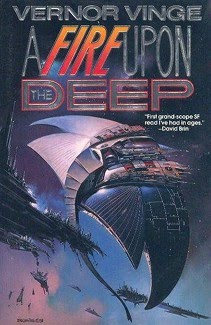
1993 Hugo (tie) – A FIRE UPON THE DEEP by Vernor Vinge


I have to say that this tie makes a lot more sense to me than the previous Hugo tie (the legendary Dune and the not-so-legendary Call Me Conrad). In 1993 we have two very different books that are both well-written explorations of classic sf themes. Both have entered the sf canon and influenced subsequent works. Willis gave us medieval human suffering via time travel. Vinge gives us similar levels of human suffering via singularity-ridden space opera.

Ah, yes, the “singularity.” I mentioned it briefly in my 2010 Hugo reviews, and I’ll probably be talking about it a lot more often from here on, in part because of the influence of Vinge. Basically, you mix together Moore’s Law and Clarke’s Laws, extrapolate a bit, and you get the idea that technology will eventually accelerate off the charts.

A Fire Upon the Deep takes place in the distant future. The Milky Way galaxy can be divided into “Zones of Thought.” Near the core are the “Unthinking Depths” where technology doesn’t work, but higher and higher technology exists the farther you get from the core. At the edge, you have “the Beyond” where post-singularity higher beings romp around. The middle “Slow Zone” allows species like humans to evolve and develop technology protected from rampaging, post-singularity “Powers.” At the beginning of the novel, a group of humans at a research base called Straumli Realm accidentally awake a particularly malevolent Power called the Blight. A small group of researchers, mostly children, escape to the medieval Tines’ World. A pair of humans, Ravna Bergsndot and the ancient, formerly dead Pham Nuwen, journey to rescue the children and try to find ammunition against the rampaging Blight.

A lot of attention is given to the Tines themselves. They’re dog-like quadrupeds, and individually, they’re basically animals. But they can communicate telepathically (or subvocally) and form small hive minds that are intelligent. This set-up allows Vinge to create a very interesting culture, especially with their technological limitations.

Big Ideas abound, and they are, on the whole, pretty darn cool. The book is not as strong on character, pacing or prose though. I didn’t care about Ravna, Pham, or the kids (and the use of the latter seemed a bit manipulative), though there were a few Tines I liked. The middle of the book drags as we get extended, and repetitive, scenes, involving a starship chase and Tine politics. The writing is fairly pedestrian; it gets the job done, but that's about it.

An even bigger problem is accessibility. When I mentioned this whole Hugo project to my local sf bookstore owner, he responded “that’s good; those books all talk to each other.” By this point, reading a book like A Fire Upon the Deep really does feel like coming into the middle of a conversation, picking up where Brin’s Uplift books left off, in this case. My fellow Hugo-reviewer Josh Wimmer started out his project asking if science fiction deserves its ghetto…this novel might suggest that it does. I really, really enjoyed Vinge’s novel, and I especially love the ideas, but can I really consider a novel great if I can’t recommend it to a non-sf-reading friend? That’s an intriguing question to me, and I’m interested to see how this problem develops throughout the ‘90s and if it explains the Hugos’ abandonment of traditional sf in the ‘00s…

Grade: A-

Wednesday, January 12, 2011

1991 Clarke and 1990 BSFA – TAKE BACK PLENTY by Colin Greenland


Science Fiction, like rock and roll, seems to flow back and forth effortlessly across the Pond. There’s a strong transatlantic tradition that goes back to the golden age (and before) which has always seen Brits like Clarke on equal footing with Yanks like Heinlein in either nation. So, it’s a bit odd to see a book perform in the awards like Take Back Plenty, which won both of the British sf awards I’m covering, and got completely ignored by all the American awards, not even receiving so much as a nomination. Odder still, I’d never heard of this novel.

It’s a space opera, though largely confined to the solar system, that follows a space hauler named Tabitha Jute and her sentient ship the Alice Liddell (whom we haven’t seen referenced since Riverworld). In this future, humans received space technology from a mysterious group of aliens called the Capellans, who retain a monopoly of sorts over trade and tech in the solar system. They take humans to the canals of Mars and to the outer solar system (in this world, fantastic visions of the planets seem to have some truth to them). There are several other weird aliens running around though, from floating space babies to the annoying little Perks to the forbidden Frasques. Jute gets caught up in some inter-species maneuvering when she takes a job from a con-man named Marco and his sapient parrot. Along the way, there are space battles, spectacular crashes, and a visit to the titular Plenty, which is an anarchic space station.

So, it’s space adventure, almost swashbuckling. The tone is fairly light and the pacing breathless. Maybe a little too breathless. The world is the main attraction here, and it’s very dense. Between the rapidly-developing plot and the barrage of alien races, the reader doesn’t have much of an opportunity to find their bearings. The novel does pause at times to give us Tabitha’s back story through a series of tales she relates to her ship’s computer, though even these are dense with new characters, species, ships, and places. Greenland’s developed a very detailed world, and it’s not entirely necessary to know all of the details. You can admire the complexity without understanding every facet. Still, it’s not the most accessible sci-fi book I’ve ever read.

In the end, Take Back Plenty is a well-written, fun book, and I can see why the British science fiction community embraced it. I can also see why it’s reputation isn’t as good in the United States – I’m not even sure it’s a cultural difference so much as a the right book hitting at the right time. This is a novel that I can easily see some sf fans loving and others not so much, depending on how willing they are to go along for the ride. Apparently, in 1990, British readers were; American readers not so much. I have to admit that I had some trouble myself. There were characters, moments, and ideas that I loved, but I’m not all that crazy about the novel as a whole. I’d still suggest that science fiction fans give it a shot though.

Also worth noting, we really are in an era of well-portrayed female protagonists after that ugly '80s drought. Tabitha is very strong and likable, and there will be others to come in the next few weeks.

Grade: B

Thursday, December 2, 2010

1988 Saturn – ALIEN NATION


District 9 received a lot of praise for the originality and social relevance of its premise. A few people noted, however, that the film Alien Nation had already used the concept of a small number of enslaved alien refugees facing racism from humans. I complained a bit that District 9 didn’t actually live up to its humanist metaphor because of action and horror tropes. Alien Nation, unfortunately, fares even worse, as the premise is largely ignored in favor of presenting an ‘80s buddy cop movie.

Buddy cop films seemed to dominate the 1980s. They’re extremely formulaic. You start with too miss-matched guys who are partnered up: tough guy/smart guy, about-to-retire guy/suicidal young guy, black cop/white cop, American cop/Asian cop, human cop/dog cop, Whoopi Goldberg cop/dinosaur cop, etc. Then, you put them against powerful gangsters who are about to introduce a new superdrug to the streets. Their boss yells at them for their unorthodox methods, and they get taken off the case, but they solve it anyway in a bloody action sequence. Sometimes it’s really dumb; sometimes it’s quite fun. Alien Nation, despite the unusual set-up, follows the formula so closely that you can forget you’re watching a science fiction film at times.

Matthew Sykes (James Caan) loses his best friend to a criminal Newcomer, one of the alien refugees that have recently settled among the general human population. He wants to find the killer Newcomer and decides that he should take on another Newcomer, recently promoted to detective due to alien affirmative action, as his partner to get on the case. At first he hates his new partner, Sam Francisco (Mandy Patankin, at the height of his career), but they grow closer as the case goes on. They discover, of course, that a whole series of Newcomer slaying are related to…wait for it….a powerful new superdrug that they must stop!

It’s a perfectly fun film, and Caan and Patankin are great actors who build some pretty decent chemistry. It seems a shame to waste such a good concept though. The film never delves into the social issues sitting just beneath the surface. I was hoping for In the Heat of the Night with aliens, but instead I got Lethal Weapon with aliens. And I'm getting too old for that shit.

Grade: B


Monday, November 15, 2010

1988 Hugo and Locus - THE UPLIFT WAR by David Brin


A sequel of sorts to Startide Rising, The Uplift War continues the story of Earthlings under siege in a galaxy of ancient, hierarchical aliens.

In Startide Rising we learned about a dolphin-crewed ship under attack after a major discovery. Here, we see the Earth-leased colony of Garth under siege by a group of bird aliens called the Gubru who want to hold the planet hostage to exhange for the dolphins' information. The central story is more-or-less that simple, but there are several intertwining subplots that Brin juggles throughout. Garth is a planet with a large neo-chimpanzee population, and we learn about the intricacies of chimp uplift, including the controversial eugenics program enforced against them. We see the development of a guerilla resistance (or gorilla resistance - ha!). We watch the complex triumvirate marriage that leads the Gubru, and we finally get to meet the prankster Tymbini, humanity's closest allies. We also discover information about the mysterious Garthlings on the ecologically devastated world - and it's here that Brin presents his best twists, especially after I initially feared that he was repeating a subplot from the previous Uplift novel. Brin also works to add more romance this time around, and we get two love triangles: one chimp, and one human/alien.

It's a very fun novel that works on a lot of the same levels as Startide Rising (one of my favorite Hugo winners so far). It's well-written and thoughtful. There's some solid speculative science, nice details and highly likable characters. And, it's fast-paced and action-packed. It also shares a lot of the earlier novel's flaws - a reliance on contrivance and deus ex machina to resolve all plot issues being the worst - and those flaws felt magnified here for a few reasons. This is the third Uplift novel, and my willingness to ignore the issues diminishes each go around - not to mention that I found neo-chimp culture far less interesting than neo-doplhin culture. And, this novel is two hundred pages longer. It feels appropriately epic for it's 600+ page length, but it doesn't feel more epic than the shorter Startide Rising...

I'd still give the Uplift books a big thumbs up overall, but if you only want to read one (and I do think they would work okay independently), I'd recommend the second. When I finish this award-winning novel project, I think the second set of Uplift books (which struck out at the awards) will be high on my "to read" list.

Grade: A-

Friday, November 5, 2010

1987 Hugo for Dramatic Presentation, 1986 Saturn – ALIENS


The return of James Cameron, as the future “king of the world” wins his first Hugo. I wish this happened more often with science fiction sequels: bring in a talented director with his own distinct vision who will take the franchise in a new direction while remaining faithful to the original material. We move from Ridley Scott’s claustrophobic horror film to a big action epic. This is also the best translation of military sf, and the mood or Starship Troopers, to the big screen.

Ripley (Sigourney Weaver) awakes from stasis following her horrific experiences in the first film into a world decades beyond her own time (Relativity!). Her employers, the greedy Company, debrief her but seem dubious of her claims. But, when they lose contact with a distant colony, they worry that the creature Ripley encountered may have struck again. A Company representative (a very slimy Paul Reiser) and Ripley join up with a tough group of space marines to check the situation out. The marines, both male and female, are tough and confidant, and Ripley warns them that they’re in over their heads. After a few encounters with a colony full of the aliens, they begin to get the point.

This is one of the great science fiction films: it’s well thought out, action packed, the effects are great and have aged well, and yet Cameron still takes time for character moments (and Weaver gives the performance of her career). It’s a completely different movie than its predecessor, but just as good. This is the last time I’ll be discussing the Alien franchise*: Alien 3 also garners a great director with David Fincher (Fight Club), but it’s early in Fincher’s career and he’s saddled with a weaker script that quickly jettisons the status quo established in this film – the results are much less satisfying. The fourth film is almost universally detested, though I don’t mind it as much as most – it’s a mediocre sf film that just looks really bad in comparison to the first two films.

*unless the prequel in development somehow actually manages to 1) get made, and 2) be good.

Grade: A-


Monday, November 1, 2010

1987 Hugo and Locus, 1986 Nebula – SPEAKER FOR THE DEAD by Orson Scott Card


A year after sweeping the big three US awards with Ender’s Game, Card did it again with a sequel, a very different book than its predecessor – the simplicity seems to be gone (or is it?), as is the repetitiveness. The result is a rather byzantine mystery story that managed to fascinate and infuriate me at the same time.

I usually avoid spoilers as much as possible, but it’s impossible to talk about this novel without mentioning a few facets of the conclusion of Ender’s Game, so readers beware.

Speaker for the Dead picks up 3000 years after Ender’s Game. Ender is regarded as a genocidal monstrosity, the worst human to ever live, but Andrew Wiggin is the sainted founder of the influential philosophy of Speaking for the Dead (which is pretty much what it sounds like). He and his sister Valentine are only in their thirties, thanks to relativity, and both generally conceal the fact that they are influential historical figures as they flit from colony planet to colony planet. Ender is called to speak for the dead at the Brazillian-Catholic colony of Lusitania, which also happens to be home to the first sentient lifeforms humanity has encountered since the buggers, called "piggies." Once on the colony, Ender must unravel several nested mysteries about the piggies and a family of xenologists who have studied them for generations. These mysteries have implications for Ender’s own past and for the future of all of humanity.

There was a lot of fascinating material in this book, and in many ways it held my attention better than the parade of school battles that was Ender’s Game. Card doesn’t shy away from using religion in his novels, and the piggies have some interesting biological and cultural characteristics. However, the novel also managed to get on my nerves, a lot, usually at the same time it was fascinating. For instance, Card sets up a family drama worthy of Tennessee Williams: two young xenologists are deeply in love, yet they cannot marry because of a dark secret. Instead, the woman marries another man, a steelworker, who she knows to be sterile, and bears six children with her xenologist lover. The children believe the steelworker to be their father, but he knows the truth, and beats his wife mercilessly, which she feels is fitting punishment for her infidelity with the man she truly loves. In the hands of a subtler, more skilled author this could make for a meaty, layered, family chronicle; however, here it’s just annoying. The dark secret is portrayed as a matter of life and death, but it turns out to be quite pointless. The reason for the lovers not marrying turns on a highly contrived, illogical, and unlikely set of future privacy laws. The characters, whose passions and traumas should be the center of this drama, all fall flat, and are simple stereotypes. Worst of all, Ender glosses over the crimes and heals the wounds of this sad situation in almost no time at all.

This last issue is symptomatic of the most infuriating thing about the book: Ender’s complete and total perfection, including his moral infallibility, which I complained about in my review for Ender’s Game. It’s much worse in Speaker for the Dead. Ender is clearly an analogue for Jesus – wise beyond human limits and carrying the weight of all human sin (through his guilt about the buggers). Again I say, “barf.”

The central complication of the novel is what Star Trek fans would recognize as a “prime directive” problem: how much should humans interfere with piggy culture? Should the piggies be allowed to evolve in their own direction, or should humans give them advanced technology? What if they’re starving? What if they earnestly want the technology? These are interesting questions with no simple answers…. Except that Ender has the simple answers, and he is always right, even though he’s completely inconsistent. Along the way, the xenologists come off as idiots, so that Ender can correct them on all sorts of factual and ethical issues. In other words, no character is allowed to breathe, think, or love except to forward perfect Ender (Don’t even get me started on the Ender-loving sentient computer, Jane). As a result, all of the characters, especially Ender himself, are completely dull and pointless.

Grade: C+