Showing posts with label Not Hugo. Show all posts

Thursday, June 30, 2011

2011 Not-a-Hugo Nominee: Dram. Pres., Short Form CAPRICA


Caprica was a fascinating show. Its ideas and themes were fascinating, how it presented them was fascinating, and its utter failure was perhaps most fascinating of all.

Let me start out by saying: I like Caprica. I wasn’t always sure that I did, but, in the final analysis, I liked it a great deal. Here’s the shocker: I liked it better than Battlestar Gallactica, and I’m more likely to revisit it in the future.

Caprica takes place some seventy years before the Battlestar reboot, and it tracks the creation of the robotic cylons. The series follows three families connected by terrorism. Daniel Greystone (Eric Stoltz) runs the massive corporation that makes highly popular virtual reality goggles. His daughter Zoe (Alessandra Torressni) is a genius who designs an artificial copy of herself. His wife, Amanda (Paula Macolmson), gets into some zany hijinks over the course of the series. The Adama family are immigrants to Caprica from Tauron. Joseph (Esai Morales) tries to assimilate while his brother Sam remains involves in Tauron crime family activities. Joseph has a son named William, a name that should be familiar to BSG fans. Zoe, and Joseph’s wife and daughter Tamara, are killed in a terrorist attack on a shuttle orchestrated by monotheists. Clarice Willow (Polly Walker) is the local monotheistic mastermind; she’s part of a large polygamous family. Zoe was a devotee of Clarice, and her surviving friend, Lacy (Magda Aponowicz), ends up getting drawn into Clarice’s plans as well.

That was probably hard to follow if you haven't seen the show - basically, it's an exploration of robotics and VR in a society riven with decadence and religious conflict. It’s also sprawling family drama with a meandering plot. It doesn’t have the clear-cut character and plot hooks of BSG, where humankind is running for its life and most of the characters are obsessed, crazy, and/or take-no-prisoners badasses. Caprica is more complex, which is why I liked it better, and probably why it failed. On top of that, you have BSG fatigue (that last half season was weird), and the overall change from an action show to a highly speculative family drama. Prequelitis shouldn’t really be a factor – we know so little about the start of the cylon war that there’s plenty of surprises possible, and the character you’re least likely to think can die actually does. Still, the show has so many strikes against it, it’s failure seems like a foregone conclusion in hindsight.

Not to mention the fact that the show is far from perfect. The first half can move extremely slowly, while the second half (with cancellation looming) zooms at an insane pace. The plots, as I mentioned, seem to wander around randomly. Amanda’s story is especially indicative of this – she’s with Daniel, then she’s not, then she is again. She hates Zoe, she loves Zoe, she has to expose Zoe, she has to save Zoe. She’s suicidal. She’s dead? She’s an undercover agent? Paula Macolmson is a trooper through it all, but the character really is a trainwreck. There’s a similar stop and start/back and forth with Joseph Adama and the avatar of his dead daughter Tamara. And, they can’t seem to decide if Daniel is pure evil or misguided and overconfident.

So, it does go off the rails on occasion, but the show has a lot to offer. The VR culture is interesting and compelling, and this may be the finest realization of cyberpunk themes on television ever. The show also does much more to establish the twelve colonies setting in one season than BSG did in four. One of my biggest complaints about BSG is that it never felt like a coherent universe. The twelve colonies on Caprica are still a bit too similar to our own Earth, but at least we get some more details about the different ethnicities and their traditions. The look of the show is fantastic as well.

Recommended episodes:

“Pilot” – The show is heavily serialized, so you have to start at the beginning. I also think that this is where the show went wrong with the audience, who were expecting something different. If you go in with an open mind, I think the show’s potential is clearer. Grade: A-

“There is Another Sky” – My favorite episode of the series explores the virtual version of Caprica City for some cyberpunk action. Grade: A

“Dirtearters” – An exploration of Tauron history through Sam and Joseph’s childhoods. This episode really offers that grounded exploration of ethnicity that I found lacking in BSG, which was more likely to bring up characters ethnicities out of the blue to serve melodramatic one-off plots late in later seasons. Grade: B+

“Here There Be Dragons”/“Apotheosis” – The premature conclusion of the series does its best to tie up loose ends and bridge the gap with BSG. It works surprisingly well, and the ending montage is especially effective. Grade: B+

Overall series grade: B

Wednesday, July 28, 2010

2010 Not-a-Hugo Nominee GALILEO'S DREAM by Kim Stanley Robinson


My third and final not-a-nominee entry. Galileo’s Dream is an ambitious work from one of sf’s most prominent (and, I’d say, best) writers, so I expected to see it on the nomination list. When it didn’t appear, I wondered if it’s late US release date (December 29th!) had hindered it in some way. For all I know, that could be the case, and it may even be eligible again next year. However, while I liked the book, now that I’ve read it, I’m not quite so miffed to see it absent from the nominee list.

Robinson’s main focus is on writing a biographical novel of Galileo Galilei, the seventeenth century scientist who made a host of discoveries that reinforced the idea that the earth revolved around the sun and paved the way for Isaac Newton a few decades later. Galileo emphasized mathematics and empiricism, and thus also influenced the modern practice of science. And, he made some of the first important observations with a telescope, discovering Jupiter’s largest moons among other celestial objects. When Galileo published his observations, he faced persecution by the Catholic Church, which had committed itself to a geocentric view of the universe that put the Earth at the center of everything (ironically, this was the result of a thirteenth century bout of rationalism in the Church that had Thomas Aquinas synchronizing Greek thinkers like Ptolemy and Aristotle with the Bible, and Aquinas was also persecuted and recanted, but that’s a whole tangent that Robinson doesn’t really get into).

So, about 3/5ths of the novel covers Galileo’s life, which is suitably operatic: he has an abusive mother, he suffers bouts of debilitating (mental?) illness, he fathers three illegitimate children with the same woman, his two daughters end up in a convent and suffer from their own illnesses, he’s caught up in court intrigues, he makes the aforementioned scientific discoveries, and he has a dramatic trial that includes forged evidence and startling testimony. There’s lots of material to work with, and though these biographical portions started out slow, I eventually came to prefer them to the science fiction portions.

So, yes, the other 2/5ths of the novel involve Galileo being plucked out of time by 31st century colonists of Jupiter’s moons. He’s pulled forward by competing factions who are involved in scientific disputes and want to alter Galileo’s destiny for their own purposes. Early on, these sections were very intriguing, and it’s fun to watch Galileo learn about Einstein (though he takes things in a little too easily). But it all gets a bit fuzzy as the story goes on, and we begin to get vague, pseudo-sciencey talk about “entanglement.” Robinson is usually known as a hard sf kind of guy, but, paradoxically, a hard sf version of time travel inevitably takes you to some sort of probabilistic, quantum mechanics-heavy view of the universe. The uncertainty principle is good science, but it’s not very satisfying from a narrative point of view: “ah, yes, you’re the Galileo who died young – or not – or both. Oh well, who cares?” This story just gets more bizarre and more pointless as it goes on, and I found some of the future discoveries about Jupiter to be just plain silly.

There are other weird decisions in the book as well. The future debates all involve the relationship between science and religion, and what it means for human history. But, it’s never explained all that well, and that entire narrative thread feels unfinished. There’s also a first-person narrator, but he generally refers to himself in the third person and drops completely out of the novel for hundreds of pages at a time. Again, I was left wondering what the point was.

There’s a lot to like here. Robinson’s writing and ideas are characteristically strong, and the Galileo material is generally compelling. But, the novel never quite comes together. It’s very unclear and uncertain, which may have been the goal…but it makes for a difficult and unrewarding read.

Grade: B-

Tuesday, July 13, 2010

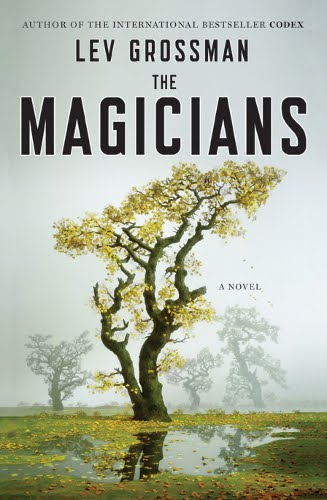
2010 Not-a-Hugo Nominee THE MAGICIANS by Lev Grossman


The Magicians is one of the most talked about fantasy novels of recent years - it's garnered a lot of mainstream attention, and it's generally considered a crossover into literary fiction. It's also divided sf fans (and readers in general). I expected it to make a few more nominee lists in the major awards, and the fact that such a successful and well-reviewed fantasy novel has not says a lot.

I should also note that we discussed this book last night at the excellent Books & Bars bookclub in Minneapolis - it combines two of my favorite things: books and alcohol. Lev Grossman did a skypechat with us, which added some nice perspective to the work.

The Magicians follows Quentin Coldwater, a gifted high schooler who is recruited to the magical college of Brakebills. There he runs into a cast of nerdy girls, effete upperclassman, and overachieving rivals, while entering into house tournaments in magical games, learning spells and potions, and facing supernatural menaces. Okay, so it probably sounds a little familiar. The Magicians is often described as an "adult Harry Potter," and that's exactly what it is...when it's at its worst. And, don't read "adult" as mature; in the early sections there's generally less emotional maturity than Harry Potter but more sex and drug abuse. The novel can feel awfully derivative, and I thought it was interesting that Grossman went out of his way to point out during our Skypechat that he wrote the earliest portions of The Magicians before he'd even heard of J. K. Rowling. The emotional immaturity also means that the characters can get on your nerves. Quentin, especially, wallows in depression and drugs, and makes some extremely bad choices. Whether this is more reflective of the real college experience seems to be one of the issues that divides readers, but I do think it's the characters who are immature, not the novel itself.

Furthermore, there is more to this novel than a speedy, low-rent Harry Potter knockoff with self-involved characters. Into the second half, the The Magicians begins to take some interesting turns and ask some more challenging questions about its subject matter. I don't really want to spoil anything, but it does become clear that Hogwarts isn't the only fantasy fiction target in Grossman's sights. I think that Fillory, an analogue for C. S. Lewis's Narnia books that Quentin grow up loving, is Grossman's best creation here.

More importantly, the novel has a lot to say about fantasy readers and the role of escapist fiction. There's a very interesting tap dance going on here: it's an homage, even a love letter, to fantasy classics from Narnia to Earthsea to Harry Potter. At the same time, Grossman asks how fantasy readers (especially himself; Grossman proclaimed his devotion to the genre multiple times in our chat) can deal with the existential disappointment of the real world. And, of course, this existential disappointment has all sorts of analogues: the many talented college and graduate students who find no jobs waiting for them when they finish...or jobs that they detest, for instance. It's a novel about finding your place in the world. I can't say it has great answers, but it poses the questions in ways that I found very interesting.

Grade: B

Thursday, June 10, 2010

2010 Not-a-Hugo Nominee YELLOW BLUE TIBIA by Adam Roberts


I’m going to review a couple of 2009 novels that did not receive Hugo nominations this year, just to give a little more context (and because I have read or planned to read these novels already). The first I want to discuss is Adam Roberts Yellow Blue Tibia, which made the shortlist as a nominee for the Clarke and British Science Fiction Awards (and made some waves when Kim Stanley Robinson suggested that it should win Britain’s prestigious Man Booker Prize for literary fiction).

It’s an odd one. The novel takes place in the Soviet Union in the 1980s, and it’s Roberts’ rendering of Soviet society on the brink of its collapse that is probably the most fascinating part of the book. The narrator, Konstantin Skvorecky, is part of a group of science fiction writers called together by Josef Stalin after World War II to design an alien invasion scenario that the USSR can use to distract the West. Forty years later, Skvorecky is a recovering alcoholic who hasn’t written in years. He picks up a job translating for Scientologists visiting from the United States, but he soon discovers that much of the scenario he helped create decades earlier is beginning to come true (beginning with the Challenger disaster). The next part of the scenario involves a nuclear reactor in Ukraine called Chernobyl.

As I said, the setting is brilliantly rendered, and Roberts gets a lot of mileage out of the science fictiony realities of the ‘80s (UFO religions, exploding spaceships, reactor meltdowns, etc.) I liked the characters, but there is a Coen Brothersesque cartoonishness to them: everyone has to be comically dimwitted, obese, or deluded. Skvorecky himself is supposed to be an elderly and broken man, and he is even further damaged as the novel progresses, but he still manages to make it through several action scenes and have a romance. The plot is also terribly convoluted and prone to seemingly random digressions like a Coen Brothers film. Overall, I do think the novel wavers too much on the line between straight sf and literary surrealism. I usually enjoy genre-bending, but, in this case, I was slightly bothered that the novel couldn’t establish a consistent tone.

Still, it’s fun and stimulating stuff. I’m not going to moan that it was robbed of a Hugo nomination, but I would recommend it, especially to fans of the Coen Bros., and I’d easily rate it above www.Wake.

Also, that’s one of the best covers I’ve ever seen.

Grade: B