Showing posts with label post-apocalyptic. Show all posts

Wednesday, November 16, 2016

2016 Hugo Winner - THE FIFTH SEASON by N. K. Jemisin

Last time, I praised Uprooted for the way it doled out its world-building. N. K. Jemisin ups the ante on this front significantly in this year's Hugo winner. The Fifth Season, the first in a trilogy, introduces a rich world full of exciting and original plot hooks that also serve as incredibly relevant allegories to our own world.

The Fifth Season takes place on a large, very geologically active continent called The Stillness. The frequent earthquakes, volcanic eruptions, and tsunamis lead to frequent "fifth seasons," which are basically periods of post-apocalyptic struggle. For millennia, one empire, the Sanzed centered in the city of Yumenes, has managed to ride out the fifth seasons with superior infrastructure and the control of people with special powers called orogenes. Orogenes can control kinetic energy on vast scales, calming the tectonic activity, among other things. Because they are so powerful, the people of the Stillness persecute orogenes violently, and the Sanzed Empire keeps them as slaves, training and indoctrinating them at a special school called the Fulcrum. And that's just the start of the world-building.

Jemisin explains all of this while alternately following an orogene recruit named Damaya, a powerful trained orogene named Syenite (they receive rings as they advance, and Syenite has five of the ten possible), and an orogene hiding as a commoner named Essun, who witnesses the beginning of a new, devastating fifth season. And there are both more details about the world (I haven't even gotten into the caste organization of the empire's communities, or comms) and a few surprises, like the inhuman race called the stone-eaters and the strange obelisks that float around as relics of a "deadciv" - a more advanced civilization destroyed by fifth seasons of the distant past. It's very dense, but I never felt lost. In fact, the book has two fairly lengthy appendices, but I got by fine without them, reading them only at the end to fill out my understanding of the world a little better. Jemisin skillfully fills the reader in, almost always showing rather than telling.

Even more impressive: despite the complexity of this world, this is very much a character-centered story. We get to know and like the central characters very much, and the plight of the orogenes is an interesting metaphor for discrimination and exploitation of ethnic groups in our own world. Jemisin convincingly shows the hatred that the orogenes face, and the slur that people use against them "rogga" takes on an appropriate power here, and their exploitation also shows through clearly (in some rather horrific instances, some of which recall the history of American slavery).

I also think Jemisin's prose has developed really well since the last novel of hers that I read - it's rich and highly readable. This was an excellent novel; the best fantasy novel I've read in a while. I ended up reading four of the five nominees this year (missing only a purely sad puppy nom - review for Seveneves and Ancillary Mercy forthcoming), so I feel pretty confident in saying that the right book won this year. I expect this to become something of a classic, unless Jemisin struggles to finish out the trilogy on the same level at which she started it.

Grade: A

Monday, October 10, 2016

2015 Clarke: STATION ELEVEN by Emily St. John Mandel

If you've been reading along, you know I have a soft spot for when writers who are taken more seriously in literary circles try their hand at science fiction. This has become more and more common in the last decade or so, but awards nominators seem uninterested, so I haven't had a lot of opportunity to review many of these books under the purview of this blog (though I do sometimes anyway). The Arthur C. Clarke award, which gave its fist novel trophy to Margaret Atwood, is a little friendlier to the lit crowd than most, and their 2015 award went to this finalist for the National Book Award and the PEN/Faulkner Award. I continue to think that genre and literary writers each bring something to the table.

Mandel's book mostly follows the collapse of civilization due to an extremely virulent epidemic that people call the Georgia Flu (originating in the European nation rather than the American state but quickly spreading through air travel). We get scenes of the immediate aftermath, a "present day" story twenty years after the epidemic that focuses on a traveling symphony/Shakespeare-performing dramatic company where our main character Kirsten Raymonde. We also return continually to the the life of famous actor Arthur Leander, who died onstage the night that the Georgia Flu arrived in Toronto. Kirsten likes to escape into the world of space opera comics about a character named Dr. Eleven, who lives on the titular Station Eleven. These stories of creative expression and survival in the past, present, and future weave in and out of each other throughout the novel, building a case, I think, for the idea that we influence each other in deep, abiding, and sometimes surprising ways that can leave ripples that survive past death and even the end of the world.

Mandel is a great writer, and she creates some really beautiful moments, even if this isn't the most innovative post-apocalyptic scenario or the most compelling plot. Some of the connections (and especially the reunions) here border on contrivance, and my biggest complaint is just how familiar this non-linear structure has become in 21st-century lit fic.

With its evocative prose and rich characters but unoriginal sf plot, this is almost the exact opposite of The Three-Body Problem, but I really enjoyed both books.

Grade: A-

Wednesday, February 22, 2012

2009 Clarke and Campbell – SONG OF TIME by Ian MacLeod


Ian MacLeod is yet another innovative Brit to break in at the start of the twenty-first century. This novel made a very good first impression on me. The prose is stunning; this is easily one of the best-written novels I’ve read for this project. I’m just not sure that the story lives up to MacLeod’s crisp and elegant language.

The novel is narrated by a British woman of part-Indian descent named Roushana Maitland. Most of it is a sort of memoir of her life through the twenty-first century, which turns out to be a rough one. As environmental disasters, war, refugee crises, and increased religious and racial strife take their toll on the world, Roushana deals with personal tragedies and becomes a violin virtuoso. This sort of dystopia pile-on isn’t especially new – I was reminded a lot of Butler’s Earthseed at times – but the perspective of a wealthy and successful artist is more original. Some of the sub-plots add some new wrinkles as well – like post-human “ghosts” and a Frankenstein’s-monster messiah figure who sells bottled water and takes Paris by storm. There’s also a framing story wherein we follow the elderly Roushana in Cornwall as she encounters and befriends a mysterious naked man who washed up on the beach.

The writing and Roushana’s story were strong enough to keep me turning the pages, but some of my initial enthusiasm wore off as the novel went on. It’s just so damned bleak. MacLeod piles hate upon disaster upon disease upon destruction. Again, this isn’t unlike Butler’s Earthseed, but there are two big differences: Roushana isn’t as strong or compelling as Olamina. She’s often lost and confused, and she ends up playing second fiddle (pun alert!) to her composer husband Claude for much of the novel. Also Earthseed was a struggle for survival, while Roushana’s privileged position precludes that exciting element. When MacLeod unleashed his final U.S.-destroying disaster, I responded with an “Oh come on!” rather than getting further absorbed in the story. MacLeod also piled on a series of “surpise” melodramatic scenes from Roushana’s personal life in some late twists that also had me rolling my eyes a bit.

So, the darkness overwhelms a well-written story about the arts, but it’s not quite dark enough to be a compelling story of survival. And all of this rather overwhelms MacLeod’s exploration of his central themes of memory and mortality. But, it was an engaging read, and I’d like to check out some more MacLeod.

Grade: B

Wednesday, May 4, 2011

1999 Nebula – PARABLE OF THE TALENTS by Octavia Butler


The Nebulas have been sort of rough of late, but I really enjoyed this novel, and its predecessor, Parable of the Sower. Together, they form one continuous story that follows a young woman named Lauren Olamina Oya in the crumbling United States of the 2020s and 30s. The novel is told mostly through Olamina’s journals (though this volume includes a few other excerpts from first person narrators, especially her husband and daughter), and much of it involves her attempts to create a new religion, called Earthseed.

Parable of the Sower begins in Southern California, which is bone dry due to climate change, and is being picked apart but bandits, drug addicts, and even cannibals. Olamina’s modest walled community eventually falls apart, and she and a few survivors must hike north along dangerous interstates in search of better climes to the north. Parable of the Talents picks up with Olamina more settled in northern California, but she must continue to contend with the United States’ fall, this time in the form of a fascistic Christian fundamentalist President.

There’s a lot of high concept science fiction material here. There’s a drug that turns people into pyromaniacs, and another drug causes a birth defect (which Olamina suffers from) that grants near-psychic levels of empathy (more a disadvantage than anything else in a world so full of pain). There are also high tech slave collars, and virtual reality “dreamasks.” And, Olamina’s religion, Earthseed, is all about the dream of interstellar travel as a way to unite humankind in troubled times (as well as the idea that “God is change,” a refrain which did get a little old to be honest). Yet, the books’ real strength is in how grounded they remain. The characters and their relationships feel incredibly real and immediate. As a result, this is one of the best post-apocalyptic works I’ve read. Butler’s prose is folksy and engaging, and the books are consistently dark and yet somehow never despairing. It just feels real.

My only problem is with some of the pacing of this book. Butler throws a lot of material in, and things begin to move very quickly towards the end (including a half-century jump at the very end). I’ve heard that Butler had considered making this a trilogy, and it might have been nice to fill these later years out. Sadly, Butler died suddenly in 2006. I’d recommend these two books, and I plan to seek out more of her work when I finish this project.

I actually liked this a little bit more than To Say Nothing. I thoroughly enjoyed both, but it has been a while since a Nebula-winner won a match-up against a Hugo-winner.

Grade: A-

Thursday, March 10, 2011

1995 Saturn SF – 12 MONKEYS


I’m surprised that this is my first and only chance to talk about Terry Gilliam in this awards round-up. He has one of the best sf film resumes of any director this side of Spielberg and Cameron, and his body of work is far more diverse and surprising than theirs. He received Hugo nominations for Monty Python and the Holy Grail in 1978, Time Bandits in 1982, Brazil in 1986, The Adventures of Baron Munchausen in 1990, and 12 Monkeys in 1996. That’s one hell of a list of great sf movies, but none of them managed to win. At least 12 Monkeys picked up a Saturn, and this is one of those instances where Saturn’s pick is more exciting and original than Hugo’s (more on that in a week). Gilliam likes surrealist stories about mentally unstable people which he augments with unsteady, drunken camera-work. This film, alongside The Fisher King, probably represents his most commercial work, but it’s also perhaps his best.

12 Monkeys is based on an experimental French film called La Jetee, which is a surrealistic romance involving a time traveler from a post-apocalyptic world. Here, James Cole (Bruce Willis) is the post-apocalyptic survivor of a horrific plague in the year 1997. He’s part of a gritty underground society that sends expeditions to the surface (where we see New York City overrun by zoo animals) and back in time to understand the plague. But, we’re warned again and again that the past cannot be changed. Cole travels back to the 1990s where he meets a mental patient named Jeffery (Brad Pitt) who spouts revolutionary rhetoric and a sympathetic psychiatrist named Kathryn Railly (Madeleine Stowe). Cole and Railly are drawn to each other due to some mysterious memories, and they eventually begin to explore the origins of the virus, which they link back to Jeffrey and his 12 Monkeys group.

It’s a tightly plotted story with incredible visuals from Gilliam and some brilliant acting. This is the first film where Brad Pitt showed his range. Stowe is wonderful, and every time I see this film, I wish she’d had a more extensive career. Willis does pretty good for Bruce Willis. Its eerie atmosphere, great story, and exploration of destiny and apocalypse make it one of the best time travel films ever made.

Grade: A


Sunday, December 19, 2010

1990 Clarke and Campbell – THE CHILD GARDEN by Geoff Ryman


In The Child Garden, Ryman brings a welcome quirkiness to the usually bleak genre of the post-apocalyptic dystopia. The novel has a dreamlike quality, and it’s heavy on metaphor. I hate to sound like a literary lightweight, buy I do generally prefer a more narrative-oriented approach; ambiguity can get old for me. But, this novel was effective nonetheless.

In the future, humanity discovers a cure for cancer and spreads it through viruses that prevent the disease among all people. Unfortunately, they later realize that they have shortened everyone’s lives by half or more as an unintended consequence, so that few people live past the age of 35. This is the sort of irony that Ryman builds the entire novel around.

Viruses are the great technology of Ryman’s future world. Viruses have been designed to convey different skills, information, and even opinions, and they propagate through the population, so that babies can be infected with a high school education. At adulthood (10 years), people’s personalities are integrated into a Consensus group mind, which rules their Communist society. Due to the side effects like the above mentioned shortened lifespan, and also apparently due to global warming, most technology has broken down. At the beginning of the novel, London is without electricity and messages are conveyed via runners.

In this world, we meet Milena, a girl who has a resistance to the viruses. She doesn’t have the knowledge or instant-learning skills of the others, but she is better equipped to learn things that are not part of the standard battery of virus-conveyed material. She also better appreciates things that are novel and different. She meets a musically talented, genetically engineered polar bear woman named Rolfa and begins to work on a massive artistic project – a holographic opera based on Dante’s Divine Comedy. Society seems both fearful and hopeful of the new ideas that Milena plans to provide.

The book fails quite spectacularly as a dystopia. To do a humorous dystopia right, I think a writer would have to lean on wry satire, but Ryman prefers sincerity and quirk. In fact, it seems at times that he’s just thrown all of the quirkiness he can think of against the wall to see what sticks – some of it works, but far from all of it. The novel seems to contradict itself at a fundamental level: the horror of this society is that everyone knows and thinks the same things due to the viruses, and we’re often told how conformist this future world is. But, the characters are all so wildly idiosyncratic that we never see that conformity. The dullest character is Milena, even though she is the one resistant to the viruses.

So, as biting social satire, The Child Garden doesn’t cut it. But I still enjoyed it quite a bit. It is fun and, at times, quite beautiful. Ryman is a skilled writer, and there are wonderful, lyrical passages describing childhood , art, love, and death. Ryman repeatedly refers to the work as a comedy, in the dramatic sense, and the transcendent and hope-filled finale was quite poetic as well.

Grade: B+

Monday, October 18, 2010

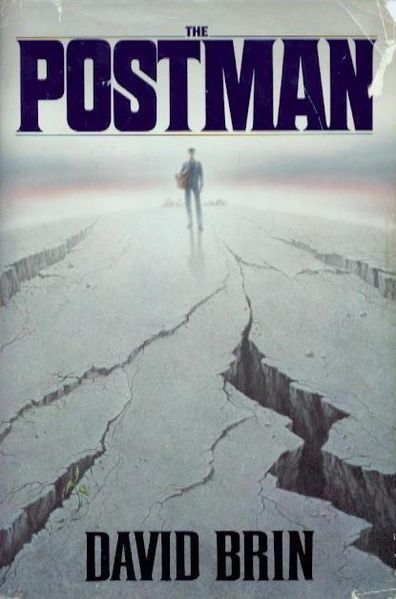
1986 Locus and Campbell – THE POSTMAN by David Brin


I recently read Cormac McCarthy’s lyrical post-apocalyptic masterpiece The Road for a book club. I think it’s going to be hard for me to read other post-apocalyptic novels after that one. I have read many of them before, including about half-a-dozen so far for this blog. As the Cold War winds down, however, they get fewer and farther between.

The novel takes place in the far-off year 2011, after waves of warfare and social destruction have wrapped around the globe following a world war that began in 1995. There were nuclear weapons, plagues, and fascistic militias. Gordon Krantz has spent much of the last sixteen years wandering across the mountain west, playing scenes from Shakespeare for food. When he discovers an old postal truck, complete with a uniform-wearing postal worker corpse, he decides that he can earn his room and board easier by delivering mail. This starts out as a cynical ploy, but he soon begins to weave a fantasy of a restored United States with a working Post Office in an attempt to unite the survivors of Oregon against a new militia attack. The messages are clear and simplistic – fascistic militias are bad, small town democracy (and America!) is good. It’s not that I disagree with these messages, but I don’t think they’re particularly interesting (though the view that a central state with strong institutions might be a good thing seems to get rarer every day). There are some more interesting ideas about the ethics of propagandistic lies, but this thread gets lost in a mélange of subplots and a manufactured action sequence that takes up the last quarter of the novel.

Actually, there are a lot of subplots here, and the novel’s biggest problem is probably how poorly they mesh. The first half is a merging of multiple novellas, and the plot does jerk through different episodes. The sub-plots also tend to really stretch the old suspension of disbelief. One involves a supercomputer* and the other a group of crazy neo-feminists. I’ve complained a lot lately about the lack of good female characters, and this novel is not an improvement: we have a comely and willing young married woman who sleeps with Gordon, and another comely-but-crazy, young neo-feminist who loves Gordon. That’s about the sum total of their characters.

I haven’t seen the Kevin Costner-starring film adaptation, which was a box office and critical failure (though I have some friends who like it), but I can see why the film might not work. The novel is a bit too transparent and sentimental in its patriotism and political messages, and it doesn't have the most cohesive plot.


*Brin wins an award for bad futurism here. He puts humans on Mars and gives them sentient AIs before the collapse…in 1995. Normally, I just let bad futurism pass with, at most, a sarcastic remark, but considering that one of the themes of the book is the problem-solving wonder of technology, it’s a tad more significant here.

Grade: B-

Friday, August 27, 2010

2010 Hugo nominee, novel: JULIAN COMSTOCK: A STORY OF 22ND-CENTURY AMERICA by Robert Charles Wilson


Last, but not (quite) least for the 2010 Hugo nominees, we have the novel Julian Comstock, by Robert Charles Wilson. I’m inclined the group Wilson in with the likes of Sawyer, Stross, Scalzi as a successful sf author from the period I’d missed out on. This novel covers a lot of the same ground as The Windup Girl, but in very different way.

Like Bacigalupi, Wilson depicts a 22nd century future in which oil supplies are exhausted with a resulting collapse of technology. There are also rampant plagues and a population collapse that has resulted from the lack of energy, disease, and infertility brought on by chemical pollution. In the wake of this collapse, reactionary political forces have taken over North America: landowners have become aristocrats, while many laborers are slaves (called indentured servants, but it is an inherited class). Christianity has become an official religion that censors scientific knowledge and enforces morality.

The narrator, Adam Hazzard, tells the story of his close friend, the titular Julian Comstock, an aristocrat and the nephew of the evil President of the United States, who killed Julian’s father. When both are young men, they are conscripted in a war against the European Union in Labrador. They are very successful, and Julian especially rises to fame through his military exploits. Meanwhile, Adam works to become a writer of adventure books and falls in love with a rebellious young woman.

Adam is an odd sort of unreliable narrator – we don’t have any reason to suspect that he’s intentionally dishonest, but he’s one of the most naïve characters I’ve ever read. As a lower class country boy from a religious background, he seems completely unaware of much of what’s going on around him. Sometimes this makes for some humorous situations, but usually it was a bit too precious. It’s also difficult to believe that a character who sees as much as Adam, who finds himself (while still very young) in the highest echelons on military, political, and artistic circles, would be so thick. I wasn’t a huge fan of the prose, which was generally very plain with the occasional Victorian affectation, and I’m not sure if this is Wilson’s voice or Hazzard’s – if the latter, it is at least more impressive. The contrivances of the plot, which puts these young men at the top of American society, also feel Victorian, and again, I’m sure this is intentional on some level, but does that make it any less annoying?

Overall, this heavy leaning on American Victoriana is the novel’s biggest fault. It feels like Wilson’s been reading some Twain and some books on the American Civil War, and he wants to tell a futuristic story in this mode. I didn’t buy the turning back that we see here – the society of Windup Girl felt a lot more like our future than Wilson’s arbitrarily resetting culture, technology, and science back to 1900. There are also some cheap political shots here that took me out of the narrative. I think my politics are pretty close to Wilson’s, and I agree with most of his critiques of the contemporary US, but I still winced, for instance, when one character explains that America’s European attackers “hate us for our freedoms.” I’d prefer a bit more subtlety in my political satire.

There is plenty to enjoy here, especially if you're looking for a post-apocalyptic novel that's a little different, and much less grim. It’s a fast-paced and easy read, and the narrator is quite likable, despite his cloying naivete. It really does capture the feeling of a boys’ adventure novel, which is certainly the intention, but I’m not sure it worked for me. Mostly, I think it suffers in comparison to the better written and more compelling work by Bacigalupi.

Next week I'll wrap up my 2010 Hugo coverage by revealing my votes and making some predictions...

Grade: B-

Friday, March 12, 2010

1979 Hugo and Locus, 1978 Nebula - DREAMSNAKE by Vonda McIntyre


Another sweep of the sf awards, and yet this is one of the books on this list that I was not familiar with. It’s been awhile since we had an old-fashioned nuclear apocalypse rather than a pollution/over-population apocalypse (other than A Boy and His Dog). It’s not entirely clear where this novel is set – there are nuclear wastelands, a desert and a mountain. There are some small villages and desert settlements, and also impenetrable, high-tech domed cities. We also hear of off-planet visitors, who may be aliens or returning colonists. It’s not entirely clear, as we never really get inside the cities (though there are indications that they’re not pleasant places). Which is all fine, I guess, since the focus really seems to be on character.

The main character is a woman named Snake, who is a “healer.” Snake’s people use genetic manipulation of snakes to produce vaccines, antibiotics and other medicines rather than venom. Snake, who gets her name for her great promise as a beginning healer, starts the novel with three snakes: a cobra and a rattlesnake for her regular medicines, and a “dreamsnake,” an odd, possibly alien, reptile, whose venom induces calm, reduces pain, and provides the patient with a willing and peaceful acceptance of death. In other words, it has a euthanasia bite. When frightened villagers kill Snake’s rare dreamsnake early in the novel, she must set out on a journey across deserts and mountains to try to replace it.

Frankly, a lot of this is post-apocalyptic boilerplate. It’s very well-written, and there are some interesting ideas about genetic manipulation in play (though McIntyre never goes too deep). I do like that there are mysteries in this world that McIntyre only hints at, as in the domes and their off-world visitors, but the mysteries that do get solved all revolve around snakes, and they're not half as interesting or exciting as McIntyre seems to think they are. I was often wondering why these genetic engineers couldn’t come up with a safer delivery mechanism for their medicines.

It’s a nice change of pace to have a female protagonist in this setting, and it's not a bad book by any stretch of the imagination, but it’s not a particularly memorable one either. At this point, I feel like an author needs a really intriguing twist or truly excellent writing (Cormac McCarthy's The Road) to wring much more out of the post-apocalyptic setting.

Grade: B

Friday, February 12, 2010

1977 Hugo and Locus - WHERE LATE THE SWEET BIRDS SANG - Kate Wilhelm


Kate Wilhelm is only the second female writer to win one of these big science fiction awards. Like Ursula K. LeGuin, she seems to be more interested in the cultural implications of technology or alternative ways of ordering society. It also reminded me a great deal of two later novels by female authors: P. D. James’ Children of Men and Margaret Atwood’s Oryx and Crake.

Once again, we’re in the ‘70s dystopian world of over-population and environmental disaster. The action begins on a small farm (I believe it’s in Virginia, but I don’t think the novel ever says for certain), where we meet David, a young medical student who has a crush on his cousin, Celia. These proceedings have the feel of a traditional family epic, but the novel quickly takes a turn. Society around the farm is crumbling, new epidemic plagues are killing millions of people around the world, and the rest are starving. At the heart of all these problems is the fact that most animals (pretty much all vertebrates) are becoming sterile, including humans and the domestic animals that they require for food. David and his family have seen the crisis coming, and they plan to save humanity through cloning. They retreat to their family farm, which they manage to defend from the death throes of humanity, and they dive into their research.

I quite loved the novel at this point. It’s an intriguing post-apocalyptic vision that moved very quickly. This all happens in the first fifty pages, and I was looking forward to the story of rebuilding human society from the ground up that I assumed Wilhelm was going to tell. But, instead, the book takes another turn. You see, as anyone who has watched a pulp science fiction movie on the subject knows, clones are eviiiiiiiiiil. David’s clones, in particular, have a weird group consciousness and are generally creepy. They take over the project of rebuilding humanity in their own creepy clone image. The latter half of the novel gets more interesting again, as we get the story of a non-cloned son of clones, Mark, who wants a return to individuality.

There are some interesting ideas here, overall, and this is a very well-written novel, but I could never really get over the implausibility of the evil psychic clones. It’s a cheesy horror-film idea at the center of an adult contemplation of changing society, and I’m afraid that it almost ruined a pretty good novel for me.

By the way, for the first time in years, we have a difference of opinion between Hugo and Nebula (the writers chose Pohl’s Man Plus over Wilhelm’s book, which was nominated). I don’t think either book was entirely successful – both suffer from shallow pop-psych views of human jealousy and betrayal and the roles that experimentation on humans would have on both. Pohl’s cyborg insanity is more believable than Wilhelm’s evil groupthink clones, but Wilhelm’s novel is brisker and more entertaining. I’ll give the nod to the Hugo winner yet again.

Grade: B

Friday, January 29, 2010

1976 Hugo for Dramatic Presentation - A BOY AND HIS DOG


Based on a Hugo Award winning novella by Harlan Ellison, A Boy and His Dog follows a young man (a very young Don Johnson) who has a telepathic link with a super-intelligent dog as they wander across a hellish post-apocalyptic landscape in 2024. Since Mad Max, this kind of “every man for himself/world of barbarians” post-apocalyptic film has become almost cliché. But, I’ll give A Boy and His Dog the benefit of the doubt and say that I don’t know of anything like this made earlier.

There’s not much to the plot. “the boy” wants to get laid, the dog wants to find a utopia called “Over the Hill,” and various savages with rifles try to enslave or kill them. Later, we get a sequence in “Downunder,” a community of more organized underground survivors who live in a parody of conformist, small-town America. Ellison hates conformism!

There’s a very low-budget, early-independent-film feeling to the proceedings, and I can see how this would become a cult classic. It is very dark. And, as I said, it’s short on plot. Blood, the dog, actually gets some great character moments; he’s the best thing about this film. And, the black comedy surprise ending is certainly worth a chuckle. The rest of the movie… well, let’s just say that I’m getting sick of these dystopias. And the next Hugo-winning movie is also about some evil totalitarian Empire. It never ends.

The film has been accused of misogyny in the past, and I think the argument has merit. You could say that the film is simply portraying a brutal and misogynistic world, but it's still disturbing how little of the perspective of the few female characters we get here. Women are either playthings, victims, or manipulators.

It also annoys me that the original trailer shamelessly rips off the original A Clockwork Orange trailer. This is no Kubrick film.

Grade: C+

Monday, November 2, 2009

1966 Hugo (tie) – ...AND CALL ME CONRAD (aka THIS IMMORTAL) by Roger Zelazny


Apparently the franchise-spawning, greatest science fiction classic of all time, ever, was just barely the best book of 1966. Yep, Dune tied with the legendary …And Call Me Conrad (later expanded and repackaged as This Immortal) by Roger Zelazny. I’m being a bit facetious, but, in hindsight, this looks like a fairly big misstep for Hugo. I know I should take Zelazny’s novel on its own merit, but it’s hard not to compare it to the novel that it shared the ’66 Hugo with. And, next to Dune, This Immortal looks pretty slight, to say the least.

This Immortal takes place on a post-apocalyptic future Earth. After nuclear Armageddon, humans were befriended by a blue-skinned alien race named the Vegans. Most humans live on Vegan colonies, and Earth’s most magnificent sites have become tourist attractions, while the rest of the planet is overrun by mutants – some of whom inexplicably look like mythological creatures like centaurs.

The story is narrated by Conrad Nimikos, a long-lived Greek. Conrad is himself hundreds of years old, and there are hints that he is a Greek God, or he may just be a mutant. He previously lived as a hero of Earth named Karaghiosis, who opposed Vegan plans to buy up all of the real estate on Earth. Ironically, he now finds himself protecting a Vegan surveyor named Myshtigo from assassins and voodoo priests.

These are interesting ideas, but none of them are explored in depth or really developed at all. In a lot of ways, This Immortal is the anti-Dune. World-building, political machinations, and noble heroes are all there, but mostly just hinted at and relegated to the background. Instead, Zelazny focuses on a brisk, action-oriented plot and creating a mysterious but amiable protagonist. The book is a quick, light read, and Conrad is likable and funny (his narration is so good humored that it took me a third of the novel to realize that Earth had become a post-apocalyptic hellhole). Maybe I can see how the WorldCon voters might be split between the heavy epic Dune and the light romp This Immortal, but the latter doesn’t really seem so deserving in retrospect.

Grade: B-

Friday, October 2, 2009

1961 Hugo – A CANTICLE FOR LEIBOWITZ by Walter M. Miller, Jr.


I think I’m safe in saying that this is the first crossover-appeal/
mainstream hit to win a Hugo Award (not counting the retros, of course). Looking ahead, it’s worth noting that several of the winners in the ‘60s are more widely known books with better literary reputations. I’m not sure if this is a matter of the American reading public giving science fiction a closer look, or the World Science Fiction Convention looking for wider approval of the genre. I suspect it’s a little of both. I don’t pretend to know much about the culture of WorldCon and the Hugo selectors, at least not yet, but I do see an interesting parallel in the hit sf Hugo winners of the ‘60s and the victories of Gaiman, Rowling, etc. in this decade. Well, more on that as we go.

Walter Miller’s A Canticle for Leibowitz is really three stories taking place after a massive nuclear war in the twentieth century, each moving the timeline forward about 600 years. In the first, we get a society that has completely rejected science and rationality - there are groups who call themselves Simpletons and live in Simple Towns and burn every book they can get a hold of. Only the monks of an isolated abbey in the American southwest try to preserve old knowledge by smuggling and hiding books from before the apocalypse (“bookleggers”). In this first story, a young initiate in the order discovers the bomb shelter of his order's founder, Leibowitz, and helps to get the man canonized. The second story returns to the abbey, where one of the monks has reinvented the lightbulb and a savant from a nearby kingdom is helping to spark a renaissance of scientific knowledge. In the third and final story (set in the 38th century AD), humanity has made major scientific advances and is beginning a program of interstellar colonization, but is again on the brink of nuclear armageddon. There’s also a possibly immortal figure wandering in the background throughout these stories who may even be Leibowitz himself...

The novel’s basic message is that history repeats itself, and as inevitably as humanity will rise from the ashes, they are also bound to cast themselves into ashes again. In other words, people never learn. The prevailing mood is tragicomic – a lot of the novel is played for laughs (especially the first section with the hapless Brother Francis), but as humanity progresses intellectually, things get darker. The last 50 pages are pretty brutal. The religious conflicts in the novel (especially a discussion of euthanasia and radiation poisoning) are a great deal more nuanced, grounded, and relevant than anything in A Case of Conscience. That said, Miller’s depiction of the Catholic Church as a refuge from the darkness of the world, unless meant to be somewhat ironic, seems a bit overly simplistic. Sure, some monks saved important classical texts, but others destroyed them (and Islamic scholars played a much bigger role in preservation of ancient knowledge).

The novel is very well-written with wry but engaging prose; however, the book does move rather slowly. We really get three character-focused vignettes without a great deal of context (only hints at intervening history and the wider world). It can get a bit repetitive and claustrophobic spending so much time in the cloistered setting of the abbey. Also, I’ve read some thrilling descriptions of alternative renaissances (see Kim Stanley Robinson’s excellent The Years of Rice and Salt), but the middle Renaissance chapter here was especially dull to me.

A Canticle for Leibowitz is a thought-provoking and at times beautiful novel, but it’s not exactly a page turner. It’s also dark….really dark. There’s a fair amount of gallows humor, but the novel almost collapses into total despair by the end.

Grade: B+